A pool water feature is anything that moves water for the sound and the look of it: wall spouts, a sheer waterfall curtain, a rock waterfall, arcing deck jets, bubblers on a step or a fountain in the middle of the pool. Almost all of them take water from the pool, push it through the feature with a pump and drop it back into the pool.
The type you choose decides how it’s plumbed, whether it needs its own pump, how much water you’ll lose to splash and evaporation, and how much cleaning it needs. Here’s how the common types compare, from our team’s experience building and renovating pools around the Western Cape.
Pool water feature types at a glance
- Spouts: two or three streams arcing out of a wall. Classic, gentle sound, easy to run off the main pump.
- Sheer descent: a smooth sheet of water falling from a wide lip. Modern look, needs plenty of flow.
- Rock waterfall: water spilling over stacked rock. Natural look, works well on a plunge pool.
- Deck jets: clear arcs of water from the paving into the pool. Fun for kids, sensitive to wind.
- Bubblers: low domes of water on a step or sun shelf. Quiet, good for small pools.
- Pool fountain: a spray or jet rising from the water. Most dramatic, most splash.
Types of Pool Water Feature and How Each One Works
| Feature | Sound | Flow it needs | Best for | Watch out for |
|---|---|---|---|---|
| Wall spouts | Steady splash | Low to medium | Feature walls, plunge pools | Scale building up on the spout tips |
| Sheer descent | Soft rush | Medium to high | Modern pools and raised walls | Lip must be dead level or the sheet breaks up |
| Rock waterfall | Natural trickle to roar | Low to high | Freeform and natural pools | Leaves and algae on the rocks |
| Deck jets | Light patter | Medium | Family pools, lit at night | Wind blows the arcs off course |
| Bubblers | Gentle gurgle | Low to medium | Steps, sun shelves, small pools | Splashing onto the paving if set too high |
| Pool fountain | Loud spray | Medium to high | Larger pools | Most evaporation and splash loss |
Spouts and scuppers
Spouts are the most common pool water feature we build. Two or three outlets, often bronze, stainless or simple pipes, set into a tiled or plastered wall so water arcs into the pool. They suit plunge pools and small courtyards, where the wall doubles as a backdrop. A scupper is the same idea with a wider, open channel instead of a round spout.
Sheer descents and waterfall curtains
A sheer descent sends water out of a long, narrow lip so it falls as a smooth, glassy sheet. It’s the clean, modern look. It needs steady, even flow and a lip set perfectly level, or the sheet breaks into streams. On wider units that usually means a dedicated pump rather than a branch off the filter pump.
Rock waterfalls and plunge pool waterfalls
Water piped to the top of a rock outcrop or a stacked stone wall and allowed to spill down suits freeform pools and natural gardens. A small rock or wall waterfall also works well on a plunge pool, where it adds sound without taking up swimming space.
Deck jets, bubblers and the pool fountain
Deck jets sit in the paving and shoot arcs of water into the pool. Bubblers sit under a few centimetres of water on a step or sun shelf and push up a low dome, which is lovely on a small splash pool. A pool fountain throws a spray up from the water itself, either from a fixed nozzle or a floating unit. Of all the pool water feature ideas, fountains make the most noise and lose the most water to the wind.
How a Pool Water Feature Is Plumbed and Powered
There are two ways to feed a feature, and the choice decides a lot about how it performs.
Running off the filter pump
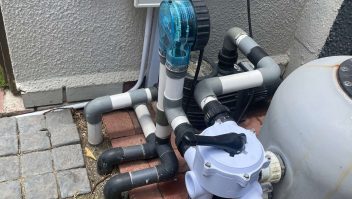
- A branch is taken off the return line after the filter
- A ball valve sets how much water goes to the feature
- No extra pump or wiring, so it’s the simplest option
- The feature only runs when the filter pump runs
- Best for spouts, bubblers and small waterfalls
A dedicated feature pump
- Its own suction line, pump and return to the feature
- Its own timer, so the feature runs only when you want it
- Strong, steady flow for sheer descents and big waterfalls
- Doesn’t rob flow from the filter and pool cleaner
- Needs its own electrical point, fitted by an electrician
Sizing matters. A feature pump that’s too small gives a weak, broken sheet; one that’s too big wastes power and splashes water out of the pool. The same thinking as our pool pump sizes calculator applies: flow, pipe length and height all count. Whatever drives it, put the feature on a pool pump timer so it runs when you’re there to enjoy it.
The pipes to a feature run under the paving, so joints have to be done properly the first time. A feature that slowly loses water is usually a leaking fitting on that line. Our post on swimming pool pipes and fittings explains how those leaks are found and repaired.
Planning a Pool Water Feature During a Build or Renovation
The easiest time to add a water feature is when the pool is new or empty for a renovation. The pipes, valves and any light fittings go in before the wall is tiled and the coping and paving are laid, so nothing has to be broken out later.
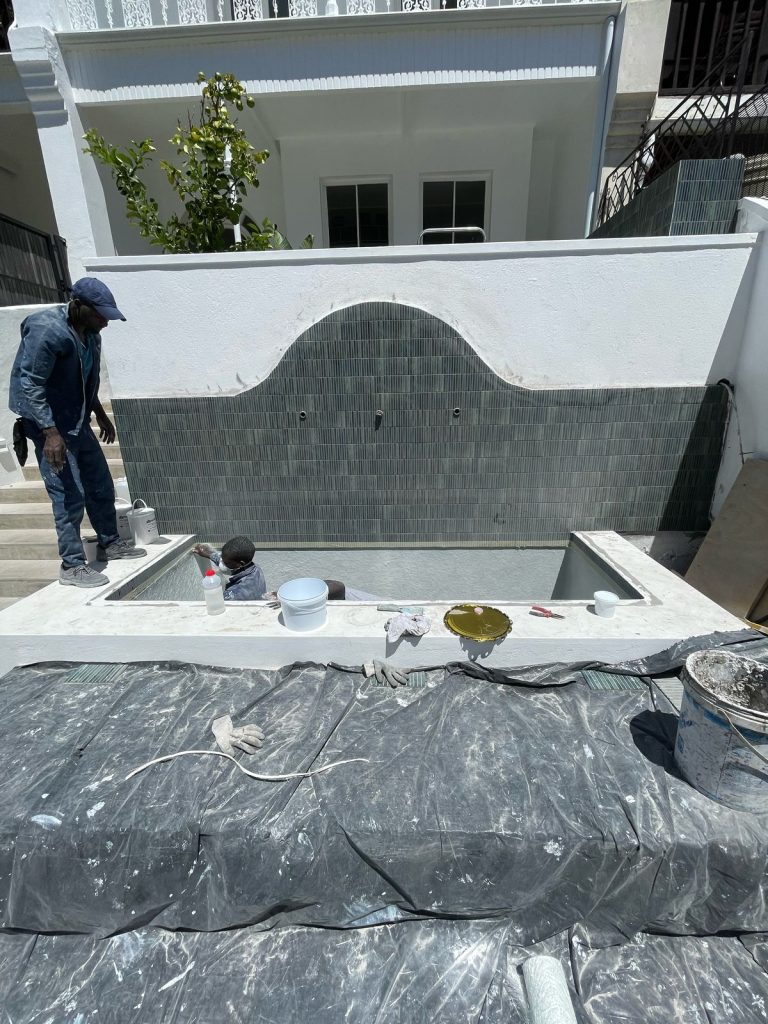
On the spout wall shown at the top of this post, the feature wall was built and tiled, with the spout pipes set in it, while the pool itself was still being finished. Doing it in that order keeps the tiles neat around each outlet and the pipework hidden.
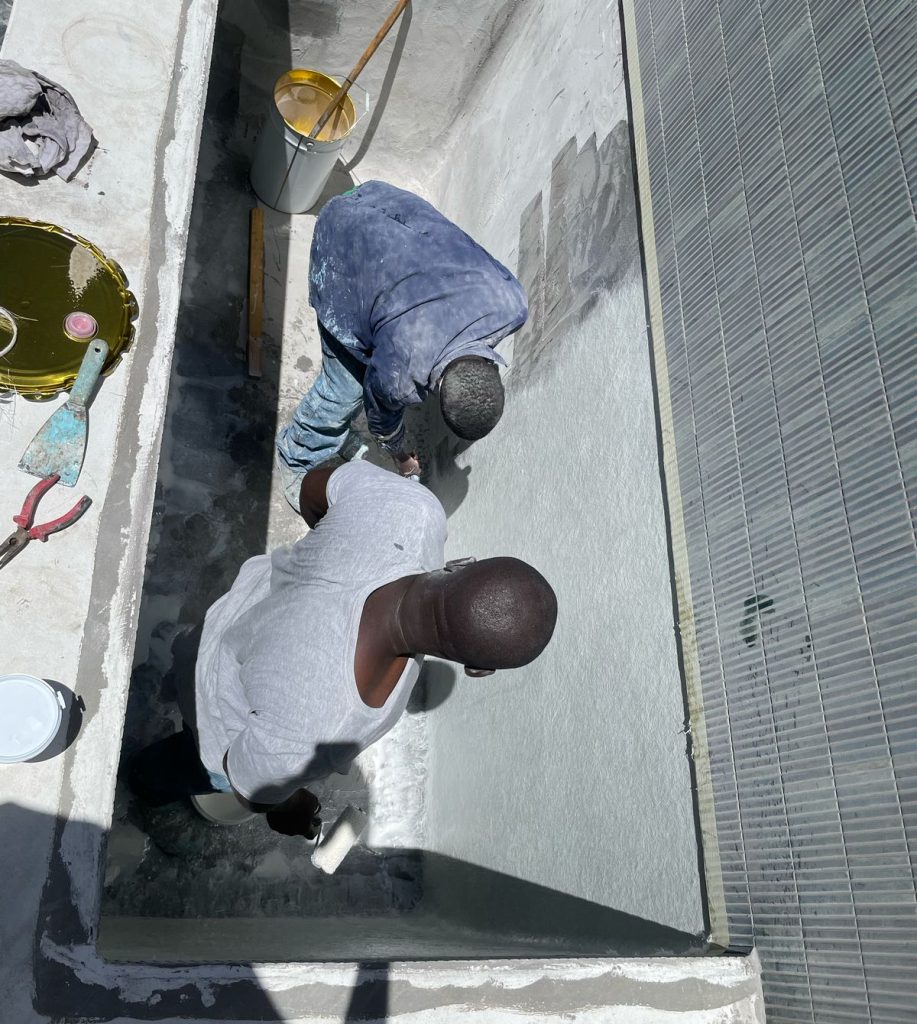
Adding a feature to an existing, full pool is still possible. Spouts on a garden wall, a rock waterfall at the edge or deck jets can often be plumbed in from outside the pool with only part of the paving lifted. If you’re planning a bigger change, our pool renovation team can fold the feature into the same job as new surfaces, lighting and coping.
Running Costs and Upkeep of a Pool Water Feature
- Electricity. A feature that runs off the filter pump adds little. A dedicated pump adds its own running hours, so a timer pays for itself.
- Evaporation and splash. Moving water evaporates faster, and a strong south-easter blows spray and arcs straight out of the pool. In summer, keep an eye on the water level so the skimmer never runs dry.
- pH creeps up. Splashing water loses carbon dioxide, which pushes the pH up. Test a little more often and read our guide to high ph in pool water.
- Scale on hard water. In parts of the Boland, white calcium crust builds up on spout tips and sheer lips and spoils the flow. Balanced water and a gentle clean keep it in check.
- Leaves and debris. Small outlets block easily in autumn. Keep skimmer and pump baskets clear.
Safety first
Feature pumps and lights are wired to the mains next to water. All electrical work, including new points, timers and light transformers, is done by a qualified electrician. Don’t open a feature pump or light fitting yourself. If a feature stops working, switch it off at the board and call our team.
Lighting a Pool Water Feature at Night
A water feature really comes alive with a light behind or below it. A small LED aimed up a sheer descent or into the spouts turns moving water into the focal point of the garden at night. Underwater lights in pools run on low voltage through a pool light transformer, and our guide to pool lights led upgrades covers the options. The colour of the pool matters too: our post on pool paint colours shows how each finish looks lit and unlit.
Thinking about a water feature?
Our team will look at your pool, pump and garden, suggest the feature that suits the space and your budget, and quote for the plumbing, building work and lighting.
Call 074 378 6623, WhatsApp us, or email info@poolsreno.co.za.
Pool Water Feature Questions Answered
Not always. Spouts, bubblers and small waterfalls can usually run off the filter pump with a ball valve on a branch line. Sheer descents, big waterfalls and fountains generally work better on a dedicated pump with its own timer.
Yes, in most cases. Wall spouts, deck jets and rock waterfalls can often be plumbed in from outside the pool with part of the paving lifted. It’s easier and neater if it’s done during a renovation, while the pool is empty.
They lose more water than a still pool, through evaporation and splash, especially on windy days. Keeping the feature height sensible, running it on a timer and switching it off in strong wind all help.
Yes. Splashing water tends to push the pH up, so test it a little more often. A feature doesn’t replace filtration, so the pump and filter still need to run their normal hours.
Bubblers and gentle sheer descents are the quietest. Wall spouts and rock waterfalls give a steady splash, while fountains and high deck jets are the loudest.