Most pools that leak don’t leak through the middle of a wall. They leak where something passes through the shell or where two parts of the pool meet: the light, the skimmer and the steps. These are the three spots our team checks first on almost every leak call in the Western Cape, and between them they account for a big share of the leaks we find.
This guide assumes you already know the pool is losing more than evaporation. If you’re not sure yet, start with our guide to swimming pool leaks and the bucket test, then come back here.
Where pools leak most often, at a glance
- Pool light: around the light niche, or along the cable conduit that runs from the back of the niche.
- Skimmer: at the joint where the skimmer mouth meets the pool wall, or through a cracked skimmer body.
- Steps: along the joint where steps meet the wall or floor, and through cracks in the treads.
- Clue: if the water drops and then stops at the same height every time, look at whatever fitting sits at that level.
Why Fittings Are Where Pools Leak
Every light, skimmer, return jet and step is either a hole through the shell or a separate piece joined to it. Those joints are sealed when the pool is built, then worked loose over the years by settling sandy soils, clay that swells in winter rain, sealants that harden with age, and renovations that laid a new finish over an old fitting without resealing it.

Leaks Around Pool Lights
Your pool light sits in a niche, a small bowl set into the wall, with a conduit running from the back of it to a junction box. Water fills the niche by design. The leak is water getting out of the pool around it.
Where a Pool Light Niche Leaks
- Around the niche rim, where the niche meets the plaster or fibreglass. Old sealant cracks and lets water seep behind the wall.
- Through the conduit, where the cable leaves the niche. If that entry isn’t sealed, water runs down the conduit and out at any crack.
- A cracked niche, usually on older pools, or where the niche was knocked during a renovation.
The signs: the water level drops to just below the light and then stops, or there’s damp ground or water in the junction box away from the pool. Water in a junction box is a safety issue as well as a leak.
Leave the light itself alone
Don’t pull the light out of its niche, cut the cable or try to reseal the conduit yourself. The light is wired to the mains, sits underwater and needs to go back with the correct seal and length of cable. If you suspect a leak at the light, switch the light circuit off at the board and call us. Light and wiring work is done by our team with a qualified electrician.
If the light simply isn’t working, see our guide to pool light bulb replacement for what a professional does, and our post on the pool light transformer.
Pool Skimmer Leaks
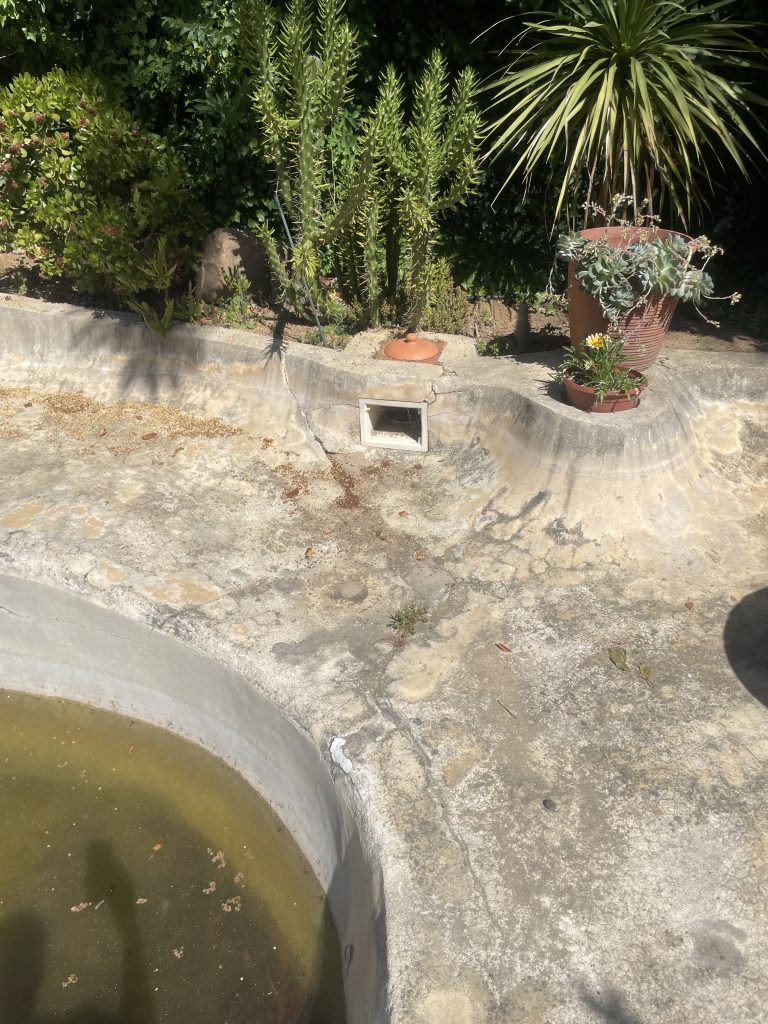
The skimmer, or weir as many of us call it, is the most common place we find a leak. It’s a separate box joined to the pool wall at its mouth, sitting under coping and paving that settles over the years.
Where Pools Leak at the Skimmer
| Leak point | What you might notice | Usual fix |
|---|---|---|
| Joint between skimmer mouth and pool wall | Level stops around the bottom of the skimmer mouth. Cracks in the plaster or tiles at the mouth. | Cut out and reseal the joint, then make good the surface |
| Crack in the skimmer body | Wet ground or sinking paving next to the skimmer. Loss continues below the mouth. | Replace the skimmer, which means lifting the coping and paving above it |
| Suction pipe below the skimmer | Loss is bigger with the pump running. Air in the pump basket. | Expose and repair the pipe connection |
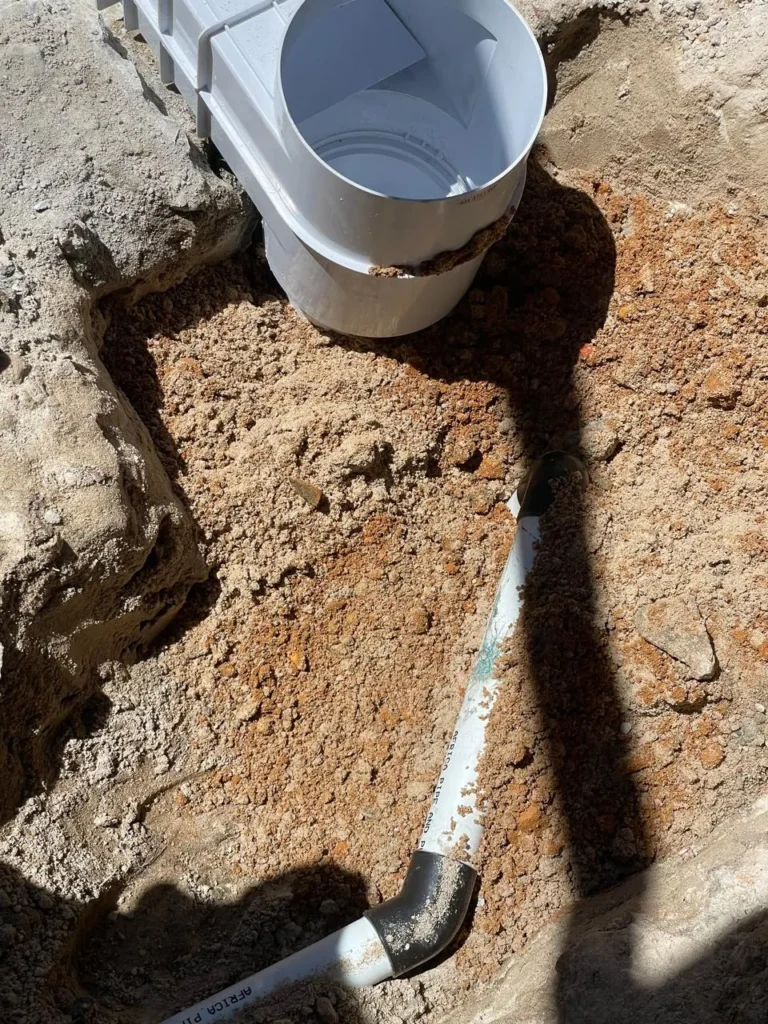
Our guide to the pool skimmer explains when it can be repaired and when it needs replacing, and our pool weir guide covers installation.
Leaks Around Pool Steps
Steps leak for a different reason. On many concrete pools the steps were built after the shell, or added later during a renovation, so there’s a cold joint where the step meets the wall and floor. On fibreglass pools, the steps are moulded into the shell and take a lot of weight and flexing, so the treads and corners crack.
Where Pools Leak Around the Steps
- The joint between the steps and the wall or floor, often a fine line of cracked plaster or missing grout.
- Hollow steps with a void underneath, where water gets in through a crack and drains away.
- Cracked fibreglass treads, especially on curved entry steps that take everyone’s weight.
Step leaks are harder to spot from the level alone, because the steps run from the top of the pool down to the floor. If the level keeps dropping right past the skimmer and light and never settles, the steps, the floor or a pipe are the likely suspects.
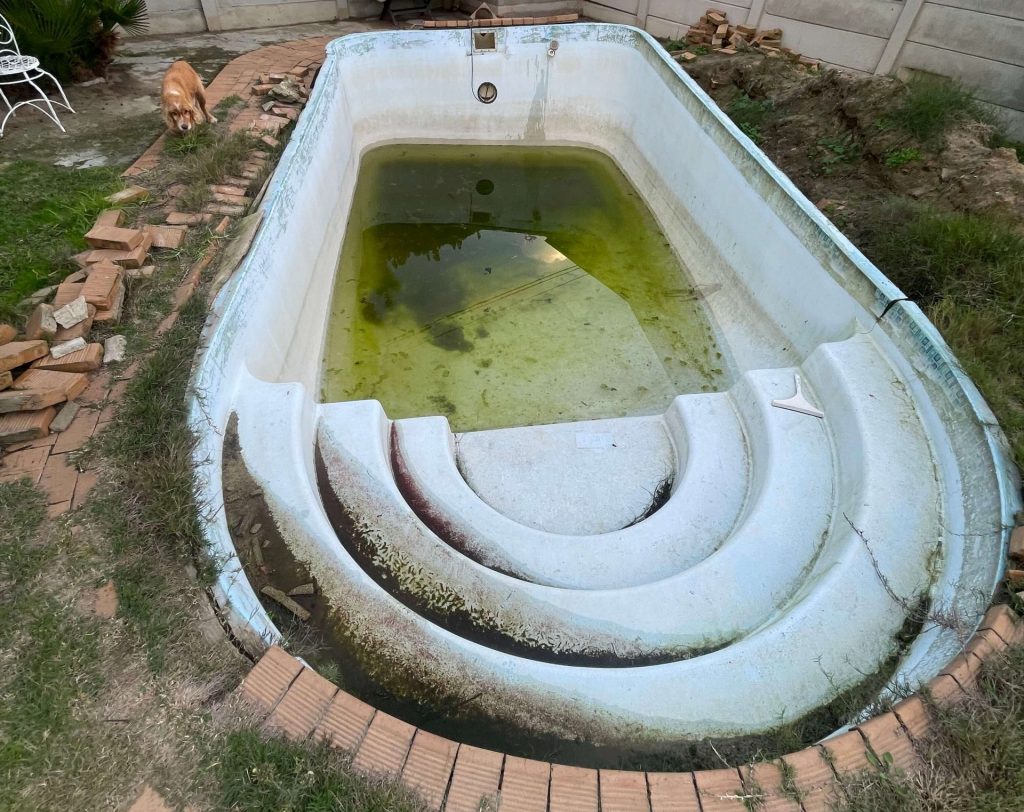
A small crack in a fibreglass step can sometimes be patched, but a crack that runs through the laminate or keeps reopening needs a proper repair. Smooth steps that have been patched should also get a non-slip finish. Our guide to pool steps covers that side of it.
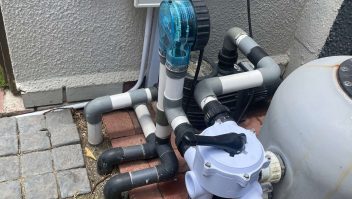
We also check the return jets, main drain and cleaner point, which leak the same way. If the loss is bigger with the pump running, the leak may be in the underground swimming pool pipes and fittings instead.
Safe Checks You Can Do Yourself
- Let the level drop for a few days without topping up and mark where it stops with tape. A level that stops at the skimmer mouth or the light is a strong clue.
- Look for wet patches, sinking paving or soft lawn behind the skimmer and along the pipe routes.
- Check the skimmer mouth, the light rim and the step joints for cracks or crumbling plaster.
- If you see water near the junction box or any electrics, switch off at the board and leave it for us.
Please don’t drain the pool to look for the leak. An empty pool can crack, and in winter, when the ground is wet, a shell can even lift. That’s a far bigger repair than any skimmer joint.
How Our Team Finds the Exact Spot
We confirm the spot before anything is cut open, using three methods:
- Dye testing at the skimmer mouth, the light rim and along the step joints. With the pump off and the water still, a little dye released next to a leak gets drawn straight into it.
- Pressure testing of the lines that run to the skimmer and other fittings, to rule the plumbing in or out.
- Electronic listening to trace water escaping underground, so if digging is needed we dig in one place.
Our page on swimming pool leak detection explains the process, and our guide on how to find a leak in a pool sets out what it costs.
How These Leaks Are Repaired
The fix depends on what’s leaking, not just where. Here’s how we usually handle each one:
Often a smaller repair
- Resealing the joint at the skimmer mouth
- Resealing the light niche rim, by our team with an electrician
- Sealing a crack at a step joint or around a return jet
Usually a bigger job
- Replacing a cracked skimmer body
- Repairing a cracked niche or conduit behind the wall
- Rebuilding a hollow step or a cracked fibreglass tread
If the finish is worn and there are several leaks, sealing them under a new lining can make more sense than patching each one. Our pool leak repairs guide walks through the options, and how to fix a pool crack explains which cracks matter.
Losing water around a fitting?
If the checks above point to the light, the skimmer or the steps, call our team. We’ll find the exact spot, explain what’s leaking and quote on the repair before any work starts. If these checks don’t explain it, call us anyway.
Call 074 378 6623, WhatsApp us, or email info@poolsreno.co.za. We also handle general swimming pool repair services once the leak is found.
Where Pools Leak: Common Questions
Yes. Water can escape around the rim of the light niche or along the cable conduit at the back of it. A level that drops to just below the light and stops there is the usual sign. The light is mains-wired, so leave it to our team and an electrician.
Watch where the level stops. If it settles around the bottom of the skimmer mouth, or you see cracks where the skimmer meets the wall or wet ground behind it, the skimmer is the likely cause. A dye test at the mouth will confirm it.
Steps are often built separately from the shell, so there’s a joint where they meet the wall and floor that can crack over time. Fibreglass steps also crack from weight and flexing. Some steps are hollow underneath, which lets water drain away through a crack.
The leak itself is a water problem, but water reaching the junction box or wiring is a safety risk. Switch the light off at the board and have it checked by our team with a qualified electrician before using it again.