If your pool is losing water, the first thing to know is that some loss is normal. On a hot, windy Cape summer day a pool can drop close to a centimetre without a single leak. The way to tell for sure is a bucket test: it takes a day, costs nothing, and compares your pool against a bucket of the same water sitting in the same sun and wind.
Here’s how much water a pool usually loses, how to run the test properly, and what the result tells you.
Quick answer
- Normal summer evaporation in the Western Cape is roughly 4 to 7 mm a day, and more when the south-easter blows.
- In winter, evaporation drops to around 1 to 2 mm a day, so a falling level in July is a red flag.
- If your pool drops noticeably more than a bucket of pool water beside it over 24 hours, you probably have a leak.
- Water that keeps dropping and then stops at the same level each time usually means the leak is at that height.
How Much Water Does a Pool Lose to Evaporation?
Evaporation depends on sun, wind, humidity and water temperature, not on how deep your pool is. That’s why the numbers are given in millimetres per day. To turn that into litres, multiply the millimetres by the surface area of your pool in square metres.
| Conditions | Typical drop per day | 8 m x 4 m pool (32 m²) |
|---|---|---|
| Winter, cool and damp | About 1 to 2 mm | About 30 to 65 litres |
| Spring and autumn | About 2 to 4 mm | About 65 to 130 litres |
| Summer, typical day | About 4 to 7 mm | About 130 to 225 litres |
| Hot day with strong wind | 8 mm or more | 260 litres or more |
Over a windy week in January that can top a thousand litres, which is why so many people are sure they have a leak when they don’t. Backwashing and splashing take water too, and exposed pools near the coast lose more on south-easter days.
The Bucket Test for a Pool Losing Water
This is the simplest, most reliable check you can do yourself. A bucket of pool water sitting in the pool loses water to evaporation at almost exactly the same rate as the pool. If the pool loses more, the difference is a leak.
- Top the pool up to its normal level and switch off any automatic top-up. Don’t backwash during the test.
- Fill a bucket with pool water to about 10 cm from the top.
- Stand the bucket on the first or second step so it sits in the pool water. The water inside should be roughly level with the pool.
- Mark the water level inside the bucket. Mark the pool level on the outside of the bucket, or on the wall with tape.
- Run the pump as you normally would and leave it for 24 hours. Pick a day with no rain and keep everyone out of the pool.
- Compare the two drops. If the pool has dropped more than the bucket by more than about 3 mm, a leak is likely.
If you find a leak, repeat the test for another 24 hours with the pump switched off. That narrows down where to look:
Loses more with the pump ON
- Points to the return side of the plumbing
- Check the pump, filter and valve area for drips
- Look for wet patches along pipe runs
- Water running from the backwash pipe when you’re not backwashing points to a worn valve
Loses the same or more with the pump OFF
- Points to the shell, a fitting, or the suction side
- Common spots: skimmer, light, main drain, cracks
- Watch where the level stops dropping
- Air bubbles from the return jets can mean a suction leak
Keep it safe
These checks are all you need to do yourself. Don’t drain the pool to look for a leak. An empty pool can crack, and in wet ground a shell can lift. Don’t open the pump motor or touch the pool light or wiring. Lights and electrics are electrician work.
If the bucket test points to a leak, call our team and tell us the two readings. It helps us start in the right place.
Other Signs a Pool Losing Water Has a Leak
You don’t always need a bucket to know something’s wrong. These clues point to a leak rather than evaporation:
- The level keeps dropping in winter or after a week of cloudy, still weather
- You’re topping up more than about 2 to 3 cm a week outside of hot, windy spells
- Soggy lawn, sinking paving or a wet patch near the pool or the pump that never dries
- Cracks in the shell or around the skimmer, or tiles coming loose at the waterline
- Algae keeps coming back and the chemicals never seem to hold, because fresh water is going in all the time
- The pump keeps losing prime or sucking air
- Your water bill has jumped and you can’t explain it
Where a Pool Losing Water Usually Leaks
When we track down leaks in Western Cape pools, these are the places we find them most often:
| Where | What you might notice |
|---|---|
| Skimmer box | Level stops at the skimmer mouth, or cracks where the skimmer meets the pool wall |
| Return jets and fittings | Level stops at the jets, or gaps around the fitting |
| Pool light | Level stops around the light. Leave the light itself to an electrician |
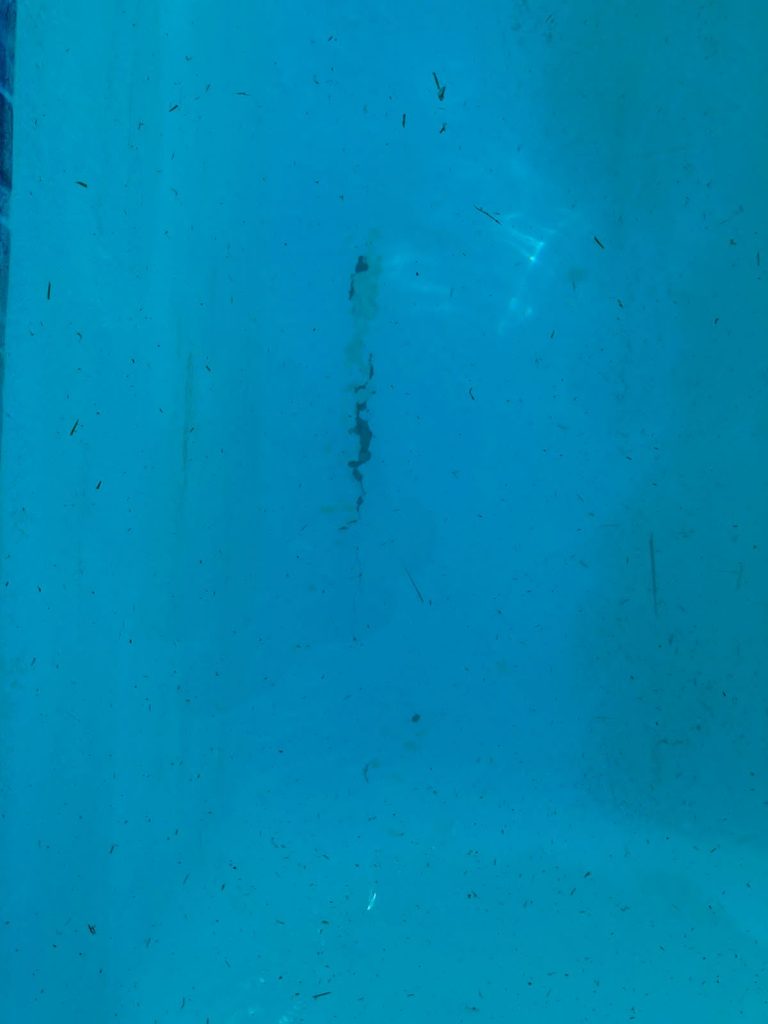
| Shell cracks | Visible cracks, often at the steps or corners of older marbelite pools |
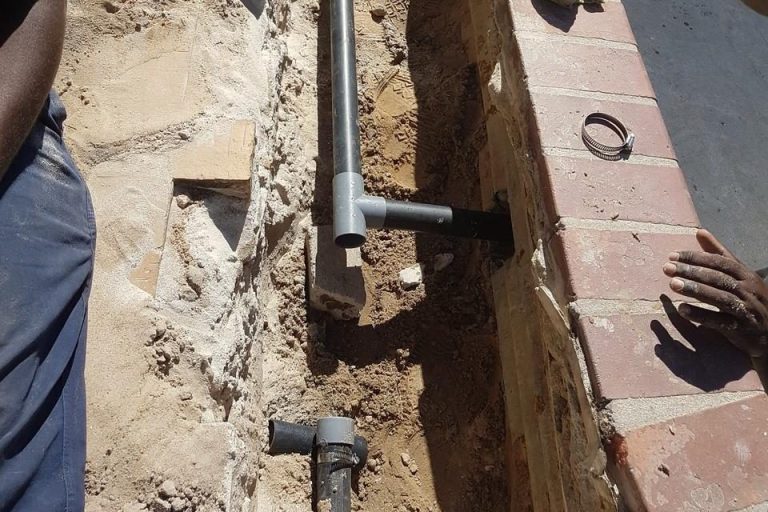
| Underground plumbing | Wet ground along the pipe route, loss bigger with the pump running |
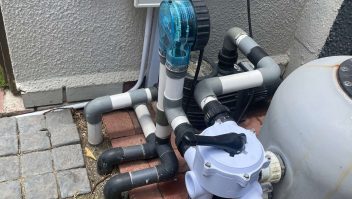
| Pump, filter and valve | Drips at unions, a wet pump pit, water running from the backwash outlet |
The skimmer is the most common culprit, especially on older pools where the ground has settled. Our guide to the pool skimmer explains when it can be repaired and when it needs replacing.
Cracks are the other big one. Hairline crazing on the surface rarely leaks, but a crack that runs through the plaster can. See how to fix a pool crack for the difference. If the whole surface is crazed and leaking in several places, pool relining is often the lasting fix.
How Our Team Finds the Leak
Once you know you’re losing more than evaporation, finding the exact spot is a job for the right tools. We use three methods:
- Pressure testing the pipes, line by line, to find out which one is losing pressure.
- Dye testing around fittings, cracks and the skimmer, where a puff of dye is drawn into the leak.
- Electronic listening to pinpoint a leaking pipe underground, so we dig in one place instead of trenching the garden.

Our page on pool leak detection explains the process in more detail, and our guide on how to find a leak in a pool sets out what it costs. Once it’s found, most leaks are a straightforward repair. See our pool leak repairs guide for what’s involved.
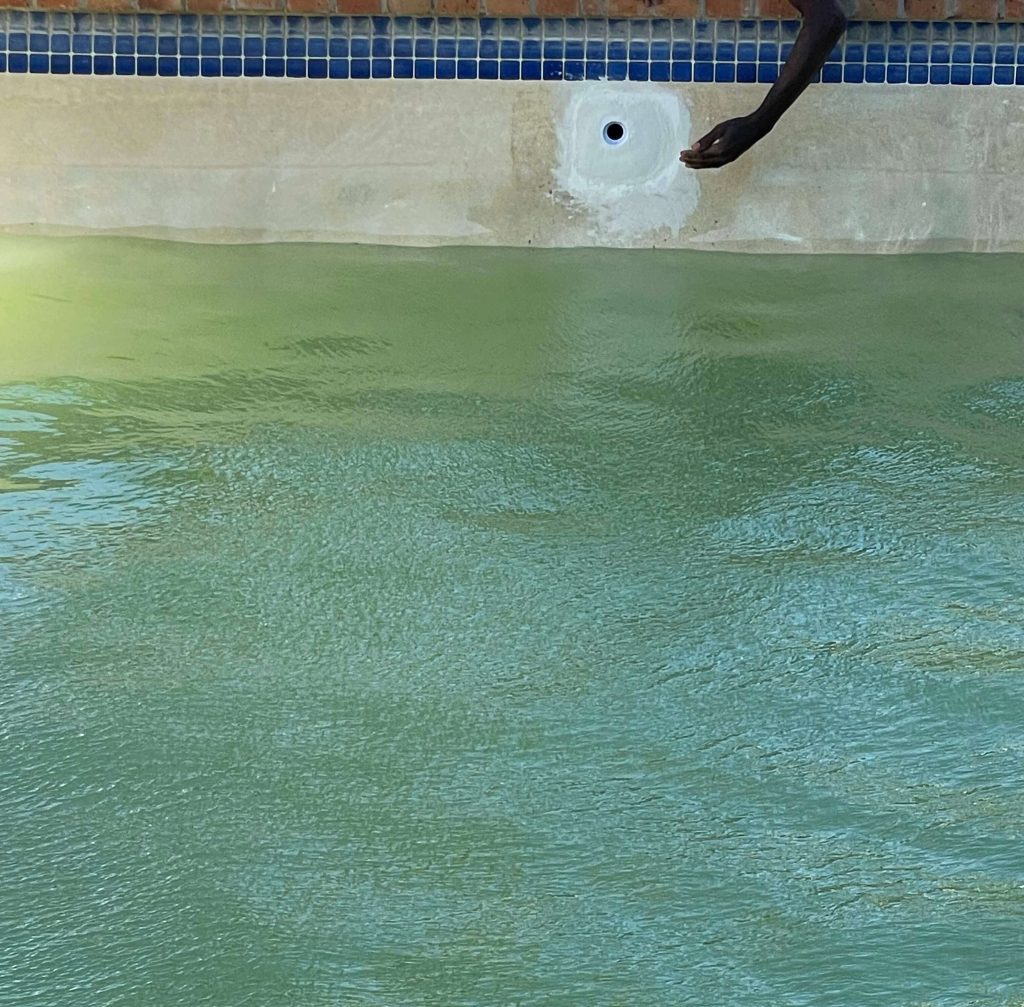
Don’t leave it too long. A leak wastes thousands of litres a month, washes out the ground under paving and pipes, and keeps throwing your water balance off.
Done the bucket test and still losing water?
If the checks above don’t explain it, call our team. Send us your bucket test readings and we’ll find the leak and quote on the repair before any work starts.
Call 074 378 6623, WhatsApp us, or email info@poolsreno.co.za. We also offer general swimming pool repair services once the leak is found.
Pool Losing Water: Frequently Asked Questions
Through evaporation, a pool in the Western Cape typically loses around 4 to 7 mm a day in summer and 1 to 2 mm in winter. Hot, windy days can push it past 8 mm. For an 8 m by 4 m pool, 5 mm a day is about 160 litres.
Do the bucket test. Put a bucket of pool water on a step, mark both levels and compare after 24 hours with the pump running as normal. If the pool drops noticeably more than the bucket, you have a leak.
That usually points to a leak on the return side of the plumbing, between the pump and the jets, where the water is under pressure. A worn backwash valve is another common cause. Pressure testing the lines will confirm it.
No. Leaks almost always get bigger as water washes out the ground and the crack or fitting wears further. The earlier it’s found, the cheaper the repair usually is.