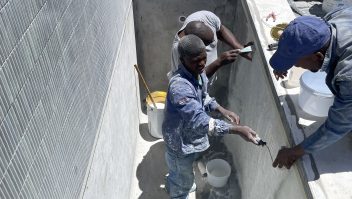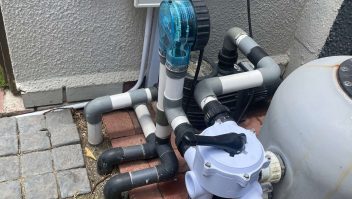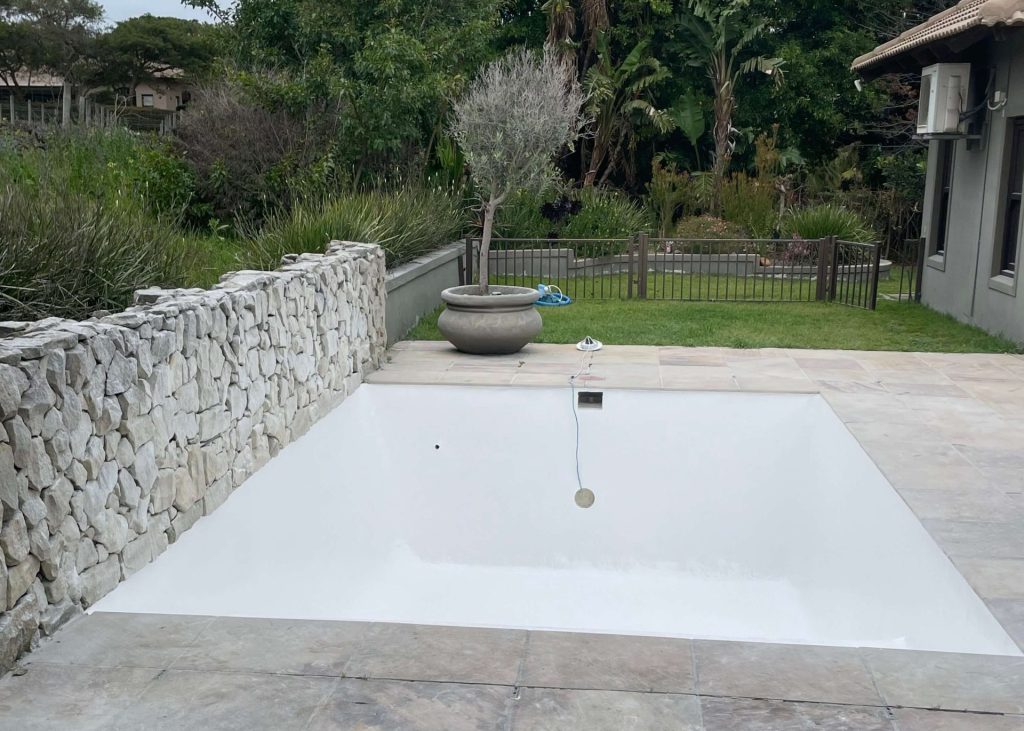
If you are considering fibreglass pool lining in Cape Town, the quality of the finished pool depends on far more than the colour or appearance of the new surface.
A professional fibreglass pool relining system begins with the condition of the existing pool shell. From there, the installer must consider surface preparation, moisture, primer selection, fibreglass reinforcement, resin chemistry, laminate construction, curing and the final poolcoat.
This becomes even more important when relining a heated swimming pool.
Higher operating temperatures, prolonged water exposure and pool chemicals create a demanding environment for the complete lining system. Consequently, choosing the correct resin and preparing the substrate properly can make a significant difference to the performance of the finished pool.
At Pools Reno, we approach fibreglass pool lining as a complete composite surfacing system rather than simply placing fibreglass over an old pool surface.
Our work covers fibreglass pool lining, fibreglass pool relining, concrete pool resurfacing, marbelite pool renovation, pool leak repairs and complete pool renovations throughout Cape Town and the Western Cape.
What Is Fibreglass Pool Relining?
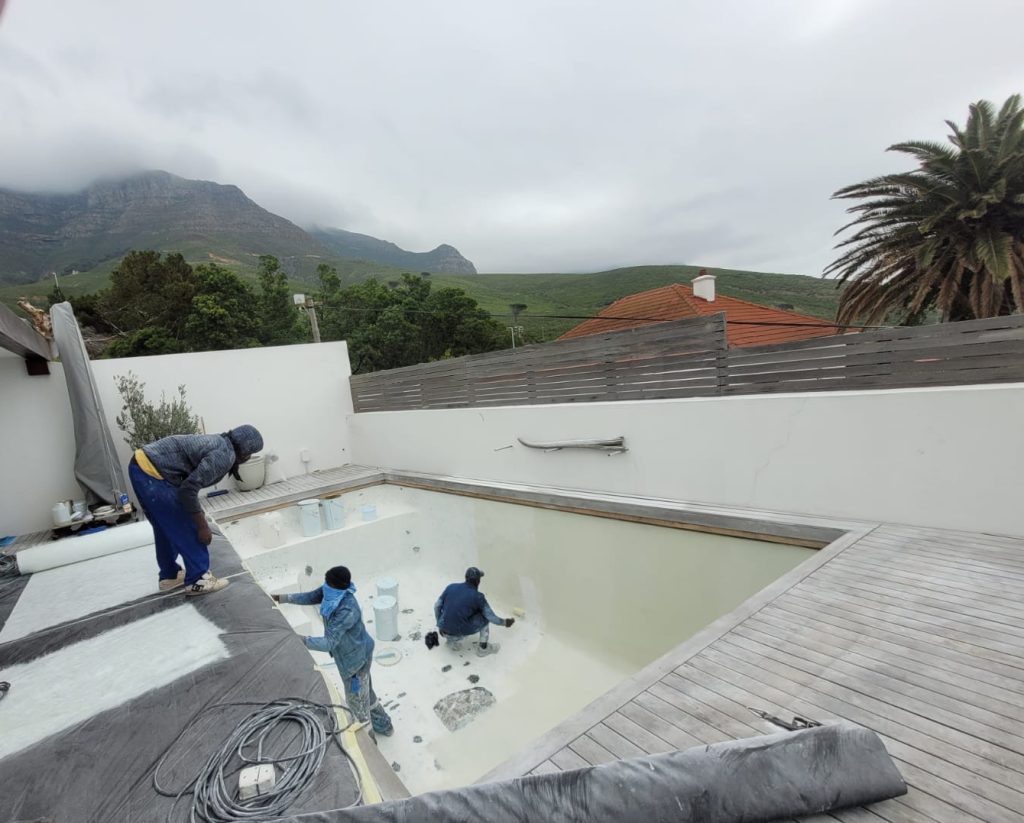
Fibreglass pool relining involves installing a reinforced composite laminate over a suitably prepared existing pool shell.
The laminate combines glass-fibre reinforcement with a compatible resin system. Once the resin cures, the glass and resin form a composite surface that can provide a new waterproofing and finishing system for the pool.
This approach can be suitable for:
- Concrete swimming pools
- Marbelite swimming pools
- Gunite pools
- Older fibreglass pools
- Cracked pool surfaces
- Leaking swimming pools
- Worn or deteriorated pool surfaces
- Pools requiring resurfacing
- Pools being converted from marbelite to fibreglass
- Pools requiring a new decorative finish
However, fibreglass lining does not automatically solve every pool problem.
For example, significant structural movement, serious shell deterioration, defective plumbing or uncontrolled groundwater may require additional work before the lining system can perform correctly.
Therefore, a proper site inspection should come before the final specification.
Why Heated Swimming Pools Require a More Carefully Considered Fibreglass System
A heated swimming pool operates under conditions that can differ from those of an unheated pool.
The water temperature can remain elevated for longer periods. Furthermore, the pool may experience repeated heating and cooling cycles throughout the year.
As a result, the complete pool lining system must tolerate its intended service environment.
Important considerations include:
- Operating water temperature
- Temperature fluctuations
- Chemical exposure
- Moisture movement
- Substrate condition
- Groundwater conditions
- Laminate construction
- Resin selection
- Poolcoat compatibility
- Long-term maintenance
For that reason, we do not recommend choosing a fibreglass pool lining system solely according to the cheapest price per square metre.
Instead, the installer should evaluate the entire pool.
GP Polyester Resin vs HETRON Vinyl Ester Resin
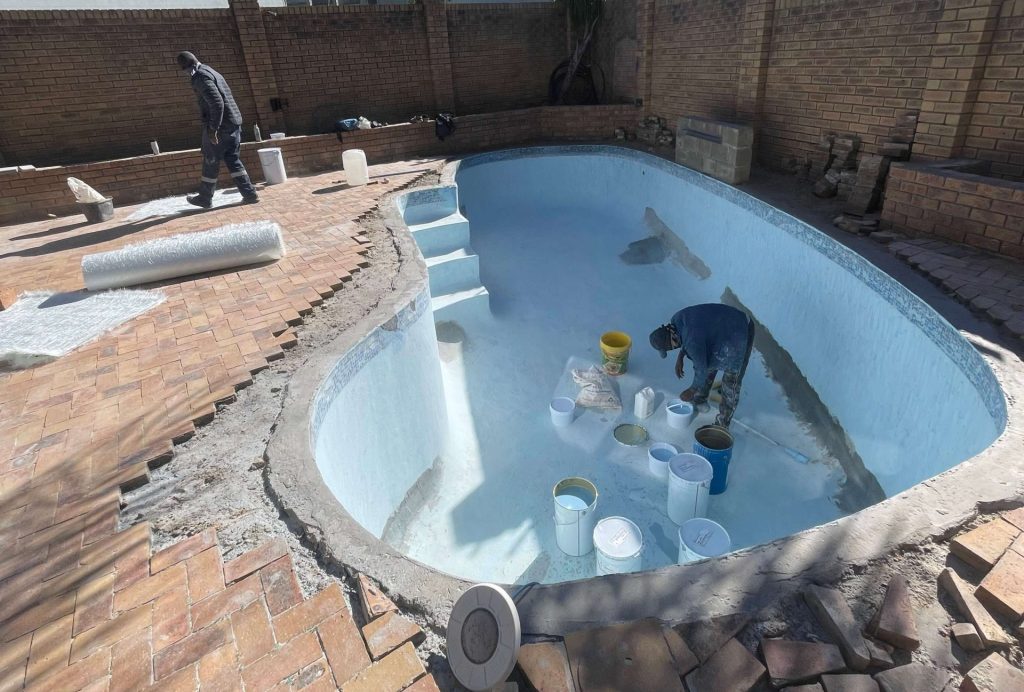
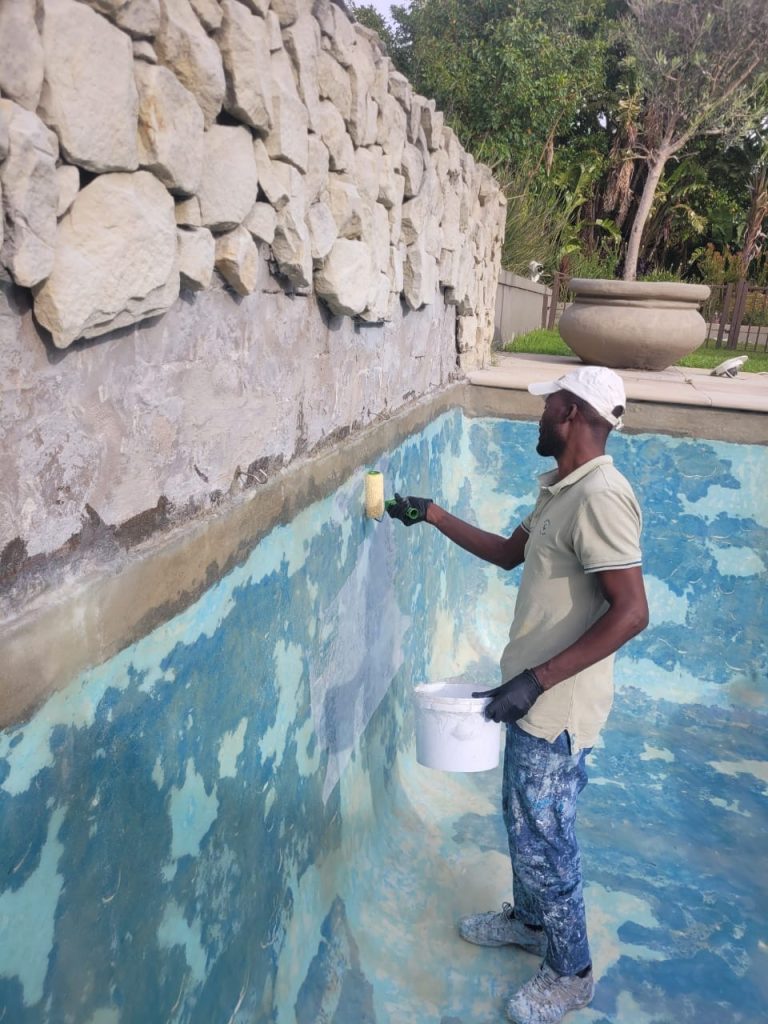
One of the most important technical differences in fibreglass pool relining involves the resin used to build the laminate.
A conventional GP polyester resin and an epoxy vinyl ester resin such as HETRON 922 belong to different resin families and have different performance characteristics.
NCS lists general-purpose unsaturated polyester resin systems within its composite range, while HETRON 922 is identified by Allnex as an epoxy vinyl ester resin designed for demanding corrosion-resistant applications and fibreglass-reinforced linings.
What Is GP Polyester Resin?
GP stands for general purpose.
A suitable GP polyester laminating resin can provide an economical solution for many fibreglass composite applications.
Its advantages include:
- Good general-purpose laminating performance
- Efficient wet-out of fibreglass reinforcement
- Familiar hand-layup processing
- Cost-effective composite construction
- Suitability for many standard applications
However, a general-purpose polyester resin should not automatically be treated as equivalent to a premium vinyl ester.
The resin chemistry, chemical resistance, toughness, thermal characteristics and moisture performance can differ significantly between products.
Therefore, the specific resin data sheet should always guide the application.
What Is HETRON Vinyl Ester Resin?
HETRON 922 is an epoxy vinyl ester resin.
Allnex describes HETRON 922 as a corrosion-resistant epoxy vinyl ester with high toughness and excellent chemical resistance. The manufacturer’s technical data also lists excellent impact strength and high tensile elongation. Furthermore, the data identifies fibreglass-reinforced linings and coatings among its suggested uses.
That makes the vinyl ester family particularly relevant when the lining must operate in a more demanding environment.
For example, a heated swimming pool can justify a more carefully selected resin system where the project requirements call for increased performance.
Importantly, resin selection should still follow the actual application and manufacturer’s technical guidance.
GP Polyester Resin vs Vinyl Ester: What Is the Difference?
| Characteristic | GP Polyester Resin | HETRON / Epoxy Vinyl Ester |
|---|---|---|
| Resin family | Unsaturated polyester | Epoxy vinyl ester |
| General-purpose composite use | Yes | Yes, where specified |
| Cost | Generally more economical | Generally higher |
| Chemical resistance | Depends on formulation | Generally higher-performance |
| Toughness | Good | High |
| Impact resistance | Depends on formulation | Strong performance characteristics |
| Thermal performance | Product dependent | Designed for demanding environments |
| Moisture/chemical environment | Product dependent | Stronger resistance characteristics |
| Heated pool application | Can be suitable when correctly specified | Attractive for demanding applications |
| Premium composite option | Sometimes | Often considered where higher performance is required |
The important point is simple:
GP polyester is not automatically inferior, and vinyl ester is not automatically necessary for every swimming pool.
Instead, the resin should match the pool.
For a standard pool with suitable conditions, GP polyester may provide a practical and economical laminate.
For a demanding heated pool or a project where higher chemical, thermal and moisture resistance is important, a suitable vinyl ester system can offer advantages.
NCS 5100: A High-Performance Vinyl Ester Option
NCS currently describes its NCS 5100 as a premium bisphenol-A epoxy-based vinyl ester resin.
According to NCS, the formulation has been optimised for improved thermal stability, excellent mechanical strength, good toughness and exceptional osmosis resistance. NCS also identifies high epoxy content and high heat-deflection characteristics among the product’s features and benefits.
These characteristics make the vinyl ester category particularly relevant to demanding composite applications.
However, homeowners should distinguish between manufacturer-tested material properties and the performance of a complete installed swimming-pool lining.
The finished pool depends on much more than resin chemistry.
Surface preparation, glass reinforcement, resin-to-glass ratio, consolidation, curing, moisture conditions and finishing materials all influence the result.
The Most Important Part of Fibreglass Pool Relining: Surface Preparation
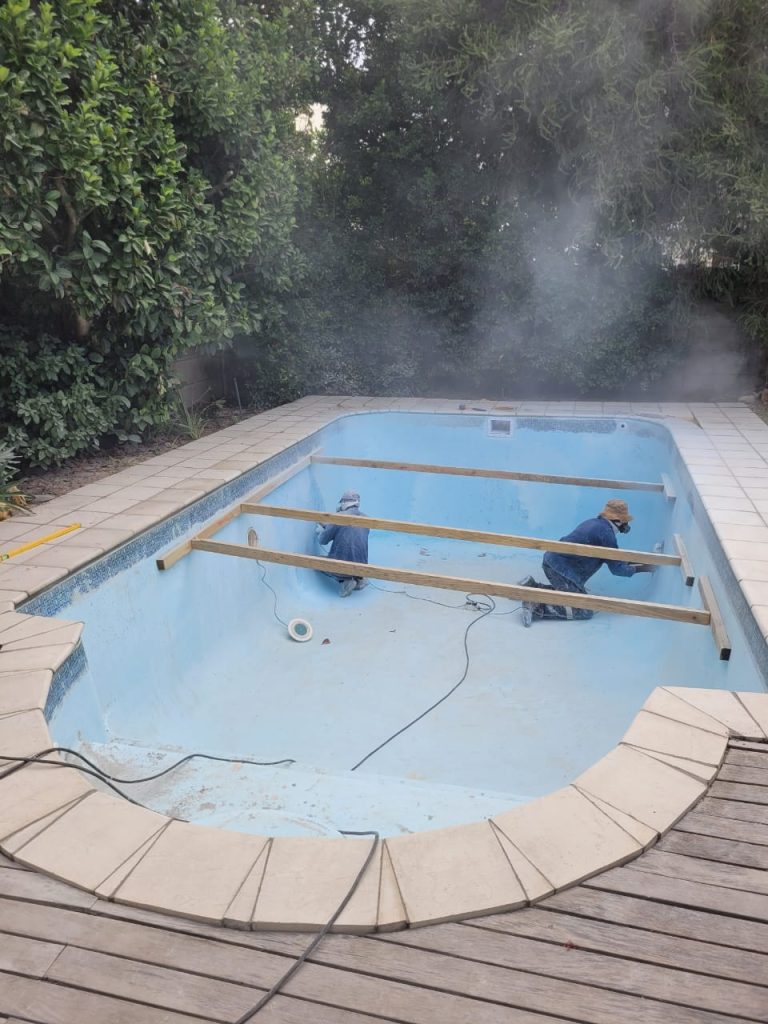
If there is one stage that homeowners should pay particular attention to, it is surface preparation.
A premium resin cannot compensate for a poorly prepared substrate.
The new laminate needs a suitable surface to bond to. Therefore, Pools Reno treats preparation as a fundamental part of the fibreglass pool relining process.
Proper preparation can involve:
- Draining the swimming pool
- Inspecting the existing shell
- Identifying cracks and damaged areas
- Removing loose material
- Removing unsuitable coatings
- Acid cleaning where appropriate
- Thorough rinsing
- Mechanical sanding or grinding
- Removing dust and contamination
- Repairing defects
- Assessing moisture
- Preparing fittings and penetrations
- Applying the appropriate primer or bonding system
- Installing the fibreglass laminate
The sequence may vary according to the substrate and manufacturer’s instructions.
Nevertheless, the principle remains constant:
The fibreglass lining is only as good as the surface underneath it.
Step 1: Drain and Inspect the Pool
The first stage involves gaining access to the complete pool surface.
Once drained, we inspect the pool for:
- Cracks
- Structural defects
- Loose marbelite
- Hollow areas
- Previous coatings
- Peeling paint
- Existing fibreglass
- Damaged steps
- Light niches
- Skimmer areas
- Return fittings
- Main drains
- Pipe penetrations
- Previous repairs
- Water ingress
- Groundwater problems
This inspection helps establish whether the existing shell can support the proposed lining system.
A fibreglass laminate should not simply cover a defect without understanding its cause.
For example, a structural crack caused by movement may require different treatment from a superficial surface crack.
Step 2: Remove Loose and Unsound Material
Next, the team removes material that cannot provide a reliable foundation.
Depending on the pool, this may include:
- Loose marbelite
- Flaking coatings
- Failed paint
- Weak surface layers
- Contaminated material
- Damaged fibreglass
- Loose repair patches
This stage can take considerable time.
Nevertheless, it is essential.
Leaving weak material underneath a new laminate can compromise the bond between the old pool and the new lining.
Step 3: Acid Cleaning of the Pool Surface
Acid cleaning can form part of the preparation process where the substrate and contamination make it appropriate.
The objective is to help remove mineral deposits and surface contamination.
However, acid cleaning does not replace mechanical preparation.
After treatment, the surface requires thorough rinsing and appropriate drying or conditioning before the next stage.
The exact chemical concentration, contact time, neutralisation and rinsing procedure should follow the relevant product and site-safety requirements.
Step 4: Thorough Sanding and Mechanical Surface Preparation
This stage deserves particular emphasis.
A smooth or contaminated pool surface does not provide the same bonding conditions as a properly profiled substrate.
Mechanical sanding or grinding can help:
- Remove weak surface material
- Remove old coatings
- Open the surface profile
- Improve mechanical adhesion
- Feather repair areas
- Smooth transitions
- Prepare corners
- Prepare fittings
- Remove contaminants
For an old marbelite pool, the surface can contain years of chemical deposits, dirt and previous treatments.
Consequently, simply washing the pool is not sufficient.
Thorough mechanical preparation creates the foundation for the new laminate.
Why New Concrete Pools Also Require Proper Preparation
New concrete does not mean automatically ready for fibreglass.
Concrete can contain:
- Cement laitance
- Dust
- Construction residue
- Surface contamination
- Weak surface material
- Form-release contamination
- Moisture
- Construction joints
- Shrinkage cracks
- Surface irregularities
Therefore, new concrete must reach the condition required by the selected fibreglass system before lamination begins.
The installer should also assess curing and moisture conditions.
Furthermore, cracks, penetrations, corners and construction joints require appropriate attention before the composite lining goes over the surface.
A new concrete pool still needs a professional preparation process.
NCS DEXA™RES 225 PA for Concrete Waterproofing Applications
NCS currently lists DEXA™RES 225 PA as a primer resin for waterproofing concrete surfaces.
This is particularly relevant when considering the interface between a mineral substrate and a fibreglass system.
The important point, however, is that a primer does not magically correct a poor substrate.
The concrete or marbelite still needs appropriate preparation first.
The primer then becomes part of the specified system.
Therefore:
Clean substrate → mechanically prepared surface → appropriate repair → compatible primer → fibreglass laminate
is a much more meaningful process than simply applying primer to an untreated pool.
Fibreglass Primer for Concrete and Marbelite Pools
Concrete and marbelite present different bonding conditions from an existing fibreglass shell.
The substrate is mineral and can be porous.
For that reason, the appropriate primer or bonding layer should be selected according to the substrate and the manufacturer’s application requirements.
Where NCS DEXA™RES 225 PA is specified for the relevant concrete waterproofing application, its role should be understood as part of the complete preparation and waterproofing system rather than as a substitute for sanding and cleaning. NCS identifies the product as a primer resin for waterproofing concrete surfaces.
For marbelite, the existing finish must first be assessed.
If the marbelite is loose, hollow, contaminated or otherwise unsuitable, the installer must address those problems before installing the new laminate.
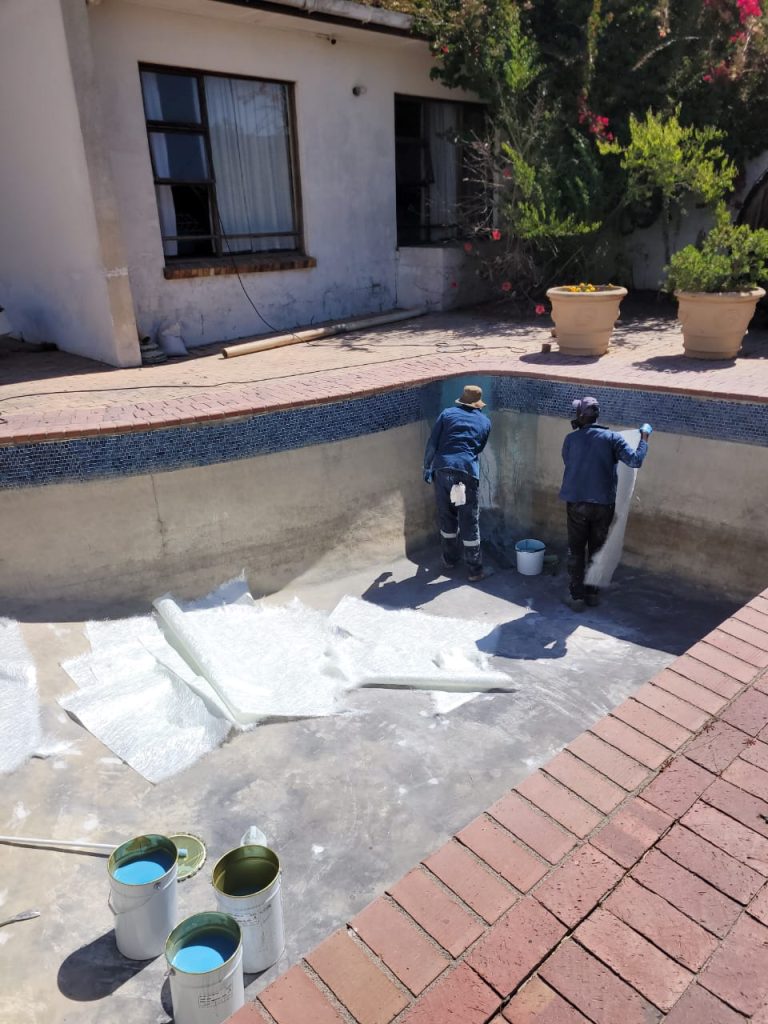
Installing the Fibreglass Mat
Once the substrate has been prepared and the appropriate bonding system has been applied, the fibreglass reinforcement can be installed.
The glass mat provides the reinforcement.
The resin wets out the glass fibres and forms the matrix that binds the composite together.
During installation, the technician needs to control:
- Resin wet-out
- Glass positioning
- Overlaps
- Corners
- Transitions
- Fittings
- Air removal
- Laminate consolidation
- Resin distribution
- Curing
Proper consolidation matters because trapped air creates voids within the laminate.
Therefore, the installer should work carefully through the laminate rather than simply flooding the surface with resin.
GP Resin or HETRON Vinyl Ester for the Fibreglass Laminate?
The answer depends on the project.
A standard GP polyester laminate may suit an appropriate pool environment.
However, a heated swimming pool can justify considering a higher-performance vinyl ester system.
HETRON 922’s manufacturer describes it as an epoxy vinyl ester with excellent corrosion resistance, impact strength and high tensile elongation, and lists fibreglass-reinforced linings among its applications.
Similarly, NCS describes its 5100 vinyl ester as providing improved thermal stability, mechanical strength, toughness and exceptional osmosis resistance.
Therefore, where the project specification calls for a higher-performance resin system, a suitable vinyl ester can provide an important upgrade.
The decision should still consider the entire system rather than one material in isolation.
The Second Option: Adding an Osmosis Barrier
Some pools deserve additional consideration.
In particular, an osmosis-barrier system can be considered where the pool faces increased moisture exposure.
Examples include:
- High water-table locations
- Persistent groundwater
- Damp surrounding ground
- Previous osmotic blistering
- Previous laminate failure
- Moisture-sensitive concrete shells
- Certain heated-pool applications
- Pools with a history of water migration
The purpose of the barrier is to provide an additional moisture-resistant layer within the specified composite system.
It is important to understand that an osmosis barrier does not eliminate groundwater.
If groundwater creates hydrostatic pressure around the shell, the underlying drainage or groundwater problem still requires attention.
Consequently, the barrier should form part of a broader moisture-management strategy.
Standard Fibreglass System vs Osmosis-Barrier System
For easier understanding, consider two potential approaches.
Option 1: Standard Fibreglass Relining System
Prepared concrete or marbelite
↓
Appropriate primer/bonding system
↓
Fibreglass reinforcement
↓
Suitable GP polyester or specified resin
↓
Laminate consolidation and cure
↓
Poolcoat
This approach can be appropriate where the pool’s condition and moisture environment support a standard specification.
Option 2: Enhanced Osmosis-Barrier System
Prepared concrete or marbelite
↓
Appropriate primer/bonding system
↓
Fibreglass laminate
↓
Dedicated osmosis-barrier tissue/system where specified
↓
Compatible resin system
↓
Laminate consolidation
↓
Cure
↓
Poolcoat
The second system adds another layer of protection where the site conditions justify it.
However, the exact placement and construction of the barrier should follow the relevant product/system specification.
Why High Water Tables Matter
Groundwater can create challenges that homeowners may not see from the pool interior.
A drained pool can still sit inside saturated ground.
Water can migrate through the surrounding soil and exert pressure against the pool shell.
Consequently, a contractor should consider the surrounding groundwater conditions before specifying a new lining.
High-water-table conditions deserve particular attention because moisture behind a composite lining can contribute to blistering and adhesion problems.
Therefore, the correct solution may involve more than fibreglass alone.
The contractor may need to investigate drainage, hydrostatic pressure, shell condition and moisture pathways before finalising the lining specification.
What Is Pool Osmosis?
The term pool osmosis commonly describes moisture-related processes within fibreglass composite structures that can contribute to blistering and laminate deterioration.
Moisture can become involved with soluble materials or voids within the laminate.
Over time, pressure can develop and produce visible blisters.
However, osmosis does not have a single cause.
Laminate construction, resin chemistry, voids, moisture exposure, substrate conditions and finishing systems can all influence performance.
For that reason, simply applying another layer of fibreglass over an existing blistered surface does not necessarily address the underlying problem.
A proper assessment should identify the cause first.
Why Vinyl Ester Can Be Valuable in Moisture-Sensitive Applications
NCS specifically describes its 5100 vinyl ester system as providing exceptional osmosis resistance in addition to improved thermal stability, mechanical strength and toughness.
That does not mean that every swimming pool requires NCS 5100 or HETRON.
Instead, it demonstrates why resin chemistry matters when designing a composite lining for a demanding environment.
The specification should consider:
Pool substrate + moisture + temperature + chemicals + laminate + resin + finish
rather than focusing on resin price alone.
Surface Preparation Around Pool Fittings
Some of the most important preparation work occurs around areas that homeowners rarely notice.
These include:
- Skimmer boxes
- Return jets
- Main drains
- Pool lights
- Steps
- Benches
- Corners
- Pipe penetrations
- Waterline transitions
Fibreglass needs to follow these areas properly.
Poor detailing can create wrinkles, bridges, voids or weak transitions.
Therefore, experienced workmanship matters particularly around fittings.
Fibreglass Pool Lining Around Steps and Corners
Steps and corners can create abrupt changes in direction.
A rigid laminate does not simply behave like paint.
The fibreglass must conform to the geometry while maintaining proper wet-out and consolidation.
For this reason, the technician needs to work carefully around:
- Step noses
- Internal corners
- Bench edges
- Swim-outs
- Radius transitions
- Light niches
Proper detailing also improves the final appearance.
The Importance of Laminate Consolidation
One of the most overlooked aspects of fibreglass pool relining is consolidation.
During lamination, the technician needs to work the resin through the glass reinforcement and remove trapped air.
Good consolidation helps produce a more uniform composite.
Poor consolidation can leave:
- Air pockets
- Dry glass
- Resin-rich areas
- Voids
- Uneven laminate
- Weak localised areas
Therefore, the quality of the laminate depends on workmanship as much as material selection.
Poolcoat: The Final Exposed Surface
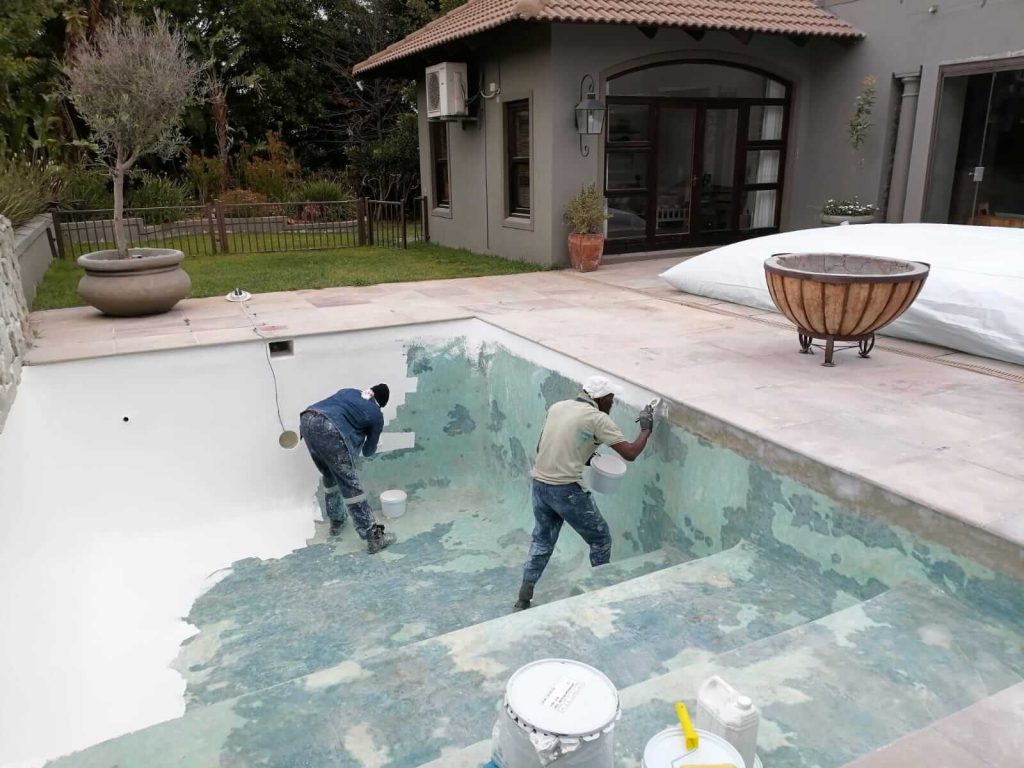
Once the laminate has cured and the surface has received the required preparation, the final poolcoat can be applied.
NCS currently lists its Poolcoat 73 series for fibreglass relining of swimming pools. NCS describes the system as an ISO/NPG surfacecoat/topcoat range for swimming-pool relining and identifies resistance to water and mild chemicals within the product information.
The poolcoat provides the exposed surface that the homeowner sees.
It also becomes part of the protection system for the laminate beneath it.
Consequently, compatibility between the laminate and finishing system matters.
Mosaic Tissue and Clear Poolcoat
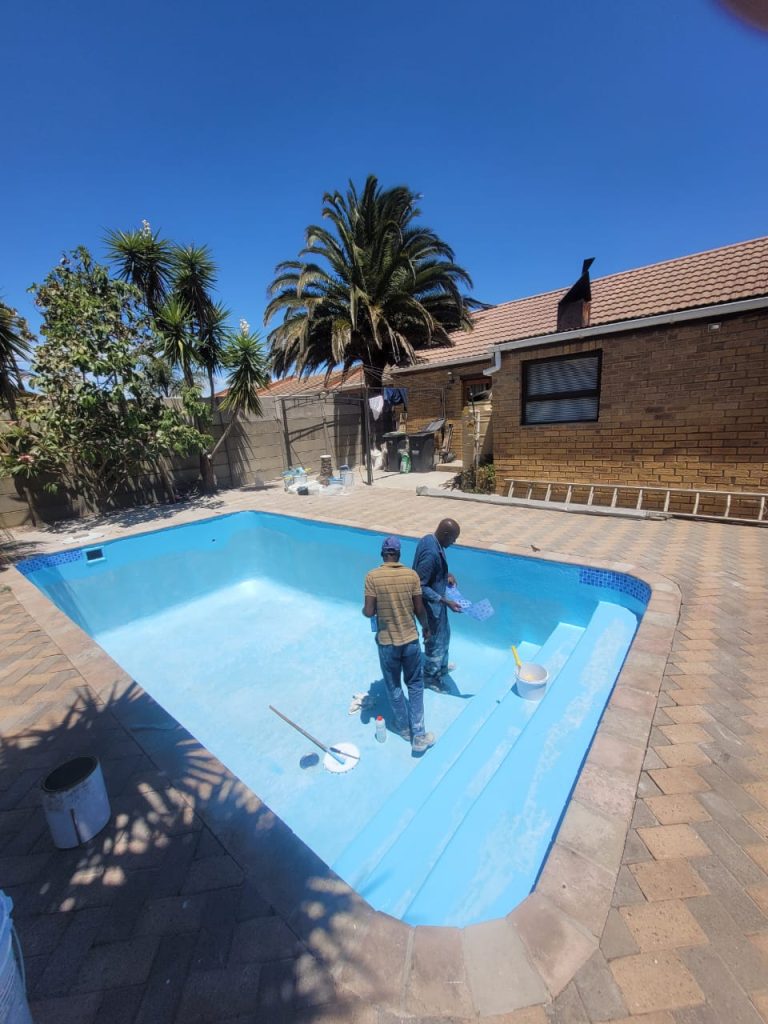
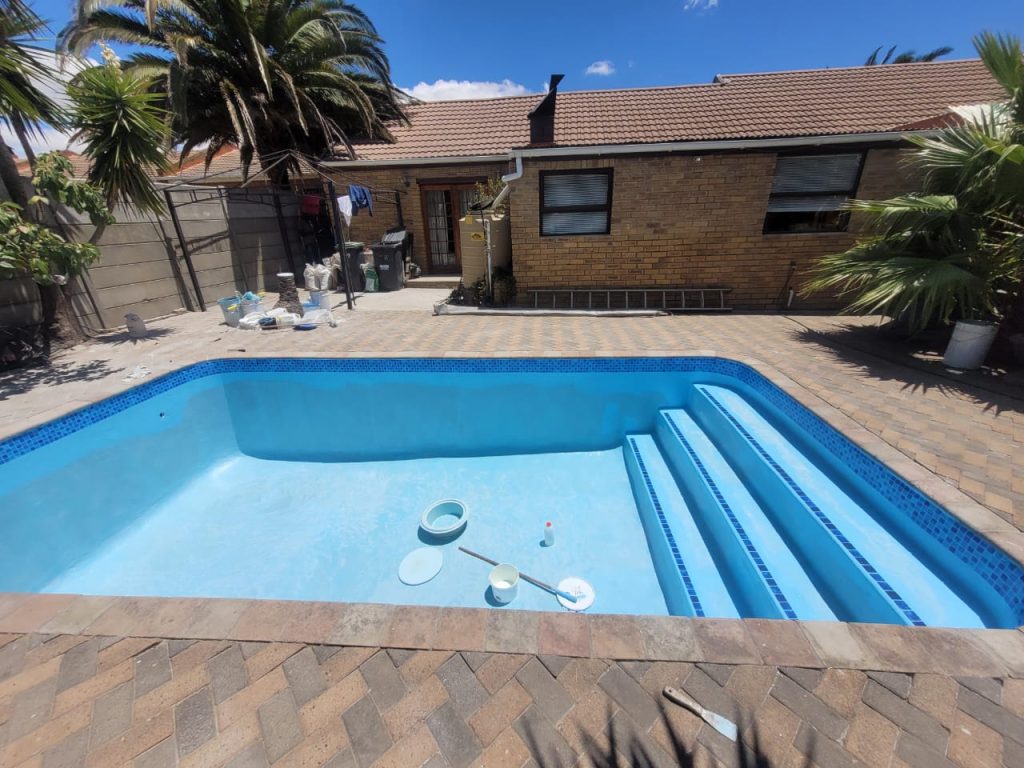
Fibreglass relining does not mean that every pool must have a plain colour finish.
Decorative mosaic finishes can also form part of a renovation system.
NCS currently lists DEXA™COAT 71 NAT / Mosaic Coat 71 as a clear pool surface coating for mosaic-tissue relining.
A decorative system can therefore involve:
Prepared substrate
↓
Fibreglass laminate
↓
Mosaic tissue
↓
Compatible clear pool coating
This approach can produce a distinctive decorative finish while retaining the advantages of a properly constructed composite lining.
Poolcoat vs Mosaic Clear Coat
These products perform different finishing roles.
Poolcoat
A pigmented poolcoat provides the visible colour and protective surface for a conventional fibreglass pool lining.
Mosaic Clear Coat
A clear coating allows decorative mosaic tissue to remain visible while protecting the finished surface.
NCS’s current leisure-pool range distinguishes between Poolcoat 73 and Mosaic Coat 71 for these different applications.
Therefore, the finish should be selected according to the intended appearance and system design.
Fibreglass Relining for Existing Concrete Pools
Concrete pools are among the most interesting candidates for fibreglass renovation.
Instead of demolishing the entire shell, a structurally suitable existing pool may be renovated by preparing the surface and installing a new composite lining.
This can potentially transform:
Old concrete pool
into
Modern fibreglass-lined swimming pool
The process can also address surface deterioration and provide a completely new finish.
However, structural assessment remains important.
A fibreglass lining should not be treated as a replacement for structural engineering where the concrete shell has significant movement or structural failure.
Fibreglass Relining for Old Marbelite Pools
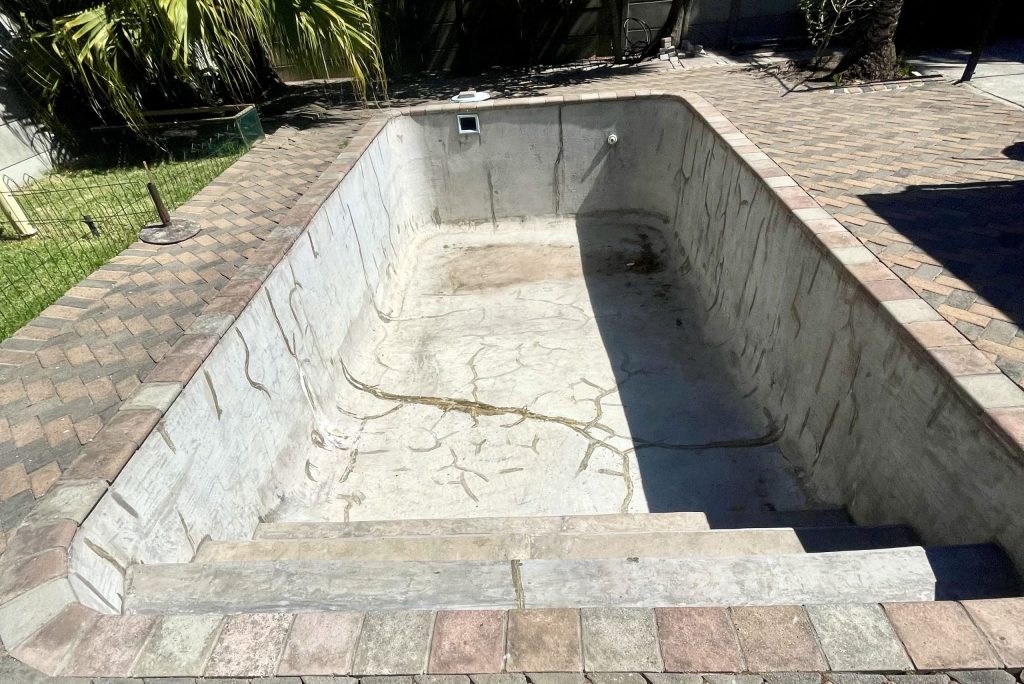
Marbelite pools can develop a range of surface problems over time.
These can include:
- Cracking
- Roughness
- Staining
- Deterioration
- Discolouration
- Algae retention
- Surface wear
- Water loss
- Failed previous repairs
When the underlying shell remains suitable, fibreglass can provide an alternative to removing and replacing the entire pool.
Before installation, however, the marbelite must be carefully assessed.
Loose or hollow areas need attention.
Contamination needs removal.
The surface requires mechanical preparation.
Finally, the installer needs to establish an appropriate bonding interface before installing the laminate.
Fibreglass Pool Relining for New Concrete Pools
New concrete pool construction also benefits from proper preparation before applying a composite lining.
Although the shell is new, it can still contain surface laitance, construction contamination, moisture and irregularities.
Therefore, the contractor should confirm:
- Appropriate concrete curing
- Suitable moisture condition
- Sound surface
- Correct surface profile
- Proper cleaning
- Defect repairs
- Compatible primer
- Suitable laminate system
A new pool is not automatically a ready-to-line pool.
Heated Pools Need Proper Water Chemistry Too
Even the best fibreglass lining requires appropriate pool maintenance.
Water chemistry affects the environment in which the poolcoat and laminate operate.
Important parameters include:
- pH
- Free chlorine
- Total alkalinity
- Cyanuric acid where applicable
- Calcium hardness where applicable
- Water temperature
- Overall chemical balance
Moreover, heated pools require particular attention because temperature changes the operating environment.
Therefore, homeowners should not assume that a premium fibreglass surface eliminates the need for correct water treatment.
Does Fibreglass Make a Pool Leak-Proof?
A properly designed and installed composite lining can form an important waterproofing layer.
However, no contractor should promise that fibreglass alone will solve every source of water loss.
A leaking pool may have:
- Cracked plumbing
- Failed fittings
- Structural cracks
- Skimmer leaks
- Light-niche leaks
- Hydrostatic problems
- Groundwater infiltration
Therefore, the source of the leak needs investigation.
Once the cause has been identified, the lining system can form part of the overall waterproofing and renovation solution.
Fibreglass Pool Relining vs Pool Painting
Pool paint primarily provides a surface coating.
Fibreglass relining introduces a reinforced composite laminate.
That difference is important.
A fibreglass system can provide:
- Glass reinforcement
- Resin matrix
- New composite surface
- New waterproofing layer
- New decorative finish
- Opportunity for surface restoration
- Optional higher-performance resin systems
- Optional moisture-barrier systems
Consequently, fibreglass becomes particularly attractive when a pool has reached the point where painting alone is no longer an appropriate renovation strategy.
Why the Cheapest Fibreglass Pool Quote May Not Be the Best Quote
When homeowners compare quotes, they often compare only the final price.
However, two quotations can look similar while specifying completely different work.
One contractor might include:
- Minimal cleaning
- Limited sanding
- Basic laminate
- Standard GP resin
- Basic poolcoat
Another might include:
- Detailed surface preparation
- Crack repairs
- Mechanical grinding
- Primer
- Higher-performance resin
- Additional laminate
- Osmosis barrier
- Detailed fitting preparation
- Premium finishing system
- Mosaic clear coat
Those are not equivalent systems.
Therefore, homeowners should ask contractors exactly what the quotation includes.
Questions to Ask Before Hiring a Fibreglass Pool Relining Contractor
Before accepting a quotation, ask:
1. What resin will you use?
Is it GP polyester, vinyl ester or another system?
2. What is the preparation process?
Will the contractor acid clean, sand, grind and repair the existing surface?
3. How will you deal with cracks?
Does the quotation include appropriate crack repairs?
4. What happens if groundwater is present?
Will the contractor assess moisture and hydrostatic conditions?
5. Is a primer required?
If so, which primer system will the contractor use?
6. Will you use an osmosis barrier?
If the pool has a high water table or previous blistering, ask whether an enhanced barrier system is appropriate.
7. Which poolcoat will you use?
Ask for the actual product system.
8. How will you prepare around fittings?
Skimmers, lights, drains and returns require careful detailing.
9. What happens before the pool is refilled?
Ask about curing, inspection and commissioning.
10. What does the warranty cover?
A meaningful warranty should clearly identify what workmanship and materials it covers.
A Professional Fibreglass Pool Relining System
At Pools Reno, we believe the finished result should come from a properly considered sequence rather than a shortcut.
The general process can involve:
Pool inspection
↓
Drain and clean
↓
Identify cracks and defects
↓
Remove loose or unsuitable material
↓
Acid clean where appropriate
↓
Thorough mechanical sanding/grinding
↓
Remove dust and contamination
↓
Repair the substrate
↓
Assess moisture and groundwater conditions
↓
Apply compatible primer/bonding system
↓
Install fibreglass reinforcement
↓
Use the specified GP polyester or vinyl ester resin
↓
Consider an osmosis barrier where site conditions justify it
↓
Consolidate the laminate
↓
Allow appropriate cure
↓
Prepare the cured laminate
↓
Apply compatible poolcoat or finishing system
↓
Install mosaic tissue and clear coat where specified
↓
Inspect the completed pool
↓
Refill and commission
This process may vary according to the actual pool and manufacturer’s instructions.
Nevertheless, it demonstrates an important principle:
A professional fibreglass pool lining is a system, not a single product.
Why Pools Reno Uses a Specification-Based Approach
Every swimming pool has a different history.
One pool may have old marbelite.
Another may have concrete.
A third may have an existing fibreglass lining.
Some pools remain dry and stable.
Others sit in areas with significant groundwater.
Some pools are heated.
Others are not.
For that reason, a one-size-fits-all approach does not always make sense.
Instead, Pools Reno can assess the pool and determine whether the project calls for:
- Standard GP polyester laminate
- Higher-performance vinyl ester resin
- Additional osmosis protection
- Concrete primer
- Extensive surface preparation
- Crack repair
- Waterproofing
- Mosaic tissue
- Clear mosaic coating
- Poolcoat
- Complete pool renovation
The specification should match the pool.
Why Surface Preparation Can Cost More Than Homeowners Expect
Preparation is labour-intensive.
Grinding an old pool takes time.
Removing failed coatings takes time.
Repairing cracks takes time.
Preparing fittings takes time.
Cleaning and vacuuming the substrate takes time.
Controlling dust and contamination takes time.
However, those steps create the foundation for the new lining.
Therefore, a quotation that includes extensive preparation can cost more than a quick-cover quotation.
The difference can be justified when the additional work reduces the risk of premature failure.
Fibreglass Pool Lining in Cape Town and the Western Cape
Pools Reno provides pool renovation and fibreglass lining services throughout Cape Town and surrounding Western Cape areas.
We work with homeowners who want to restore:
- Old concrete pools
- Marbelite pools
- Fibreglass pools
- Heated swimming pools
- Leaking pools
- Cracked pools
- Deteriorated pool surfaces
Our service area includes suburbs and towns across the Cape Town metropolitan region and the wider Western Cape.
That includes areas such as:
Durbanville, Constantia, Tokai, Hout Bay, Camps Bay, Bishopscourt, Stellenbosch, Somerset West, Bellville, Brackenfell, Kuils River, Paarl, Wellington, Strand, Table View, Bloubergstrand, Milnerton, Claremont, Newlands, Bergvliet, Plumstead and surrounding areas.
Why Choose Pools Reno for Fibreglass Pool Relining?
Choosing a pool renovation contractor should not come down to price alone.
The contractor needs to understand the relationship between:
substrate + preparation + resin + fibreglass + moisture + finishing system + pool chemistry.
At Pools Reno, we focus on the complete renovation process.
That means assessing the existing pool before deciding how to line it.
It also means paying attention to the areas that are often overlooked:
- Surface preparation
- Crack treatment
- Fittings
- Moisture
- Groundwater
- Resin selection
- Laminate consolidation
- Final poolcoat
- Decorative finishes
For demanding heated pools, we can consider higher-performance resin options where appropriate.
Where groundwater conditions create additional risk, we can also assess whether an enhanced osmosis-barrier system deserves consideration.
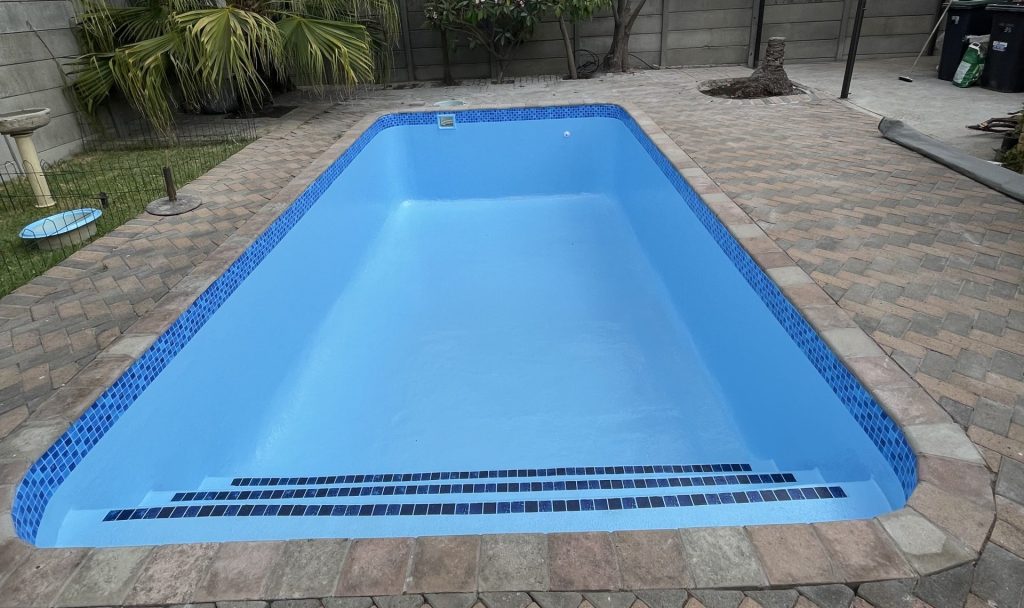
Final Verdict: What Makes a Fibreglass Pool Lining System Professional?
A professional fibreglass pool lining is not simply:
Instead, it is a carefully considered composite system.
The quality begins with the substrate.
Then comes proper preparation.
After that, the contractor selects the appropriate primer and laminate.
Next, the resin system must suit the intended environment.
Where conditions justify it, the installer can introduce additional osmosis protection.
Finally, the pool receives a compatible finishing system such as poolcoat or a decorative mosaic clear-coat system.
For heated swimming pools, these decisions become even more important.
A suitable GP polyester resin can provide an economical solution for appropriate applications. However, a high-performance vinyl ester such as HETRON 922 or an appropriate NCS vinyl ester can offer advantages in demanding environments. HETRON 922 is an epoxy vinyl ester with documented chemical resistance, toughness and impact-strength characteristics, while NCS 5100 is described by NCS as a premium epoxy-based vinyl ester with improved thermal stability and exceptional osmosis resistance.
Ultimately, however, the best resin cannot rescue a badly prepared pool.
The most important rule in fibreglass pool relining is simple:
Prepare the surface properly before you install the fibreglass.
That principle applies to old marbelite pools, concrete pools, existing fibreglass pools and new concrete pool construction.
When preparation, resin selection, laminate construction, moisture management and finishing all work together, the result is far more than a cosmetic resurfacing.
It becomes a properly considered fibreglass pool renovation system.
Frequently Asked Questions About Fibreglass Pool Lining
Can you fibreglass over an old marbelite pool?
Yes, provided the existing shell and substrate are suitable. However, loose, hollow, contaminated or unstable areas must receive appropriate attention before the fibreglass laminate is installed.
Can you fibreglass a concrete swimming pool?
Yes. Existing concrete pools can often be renovated with a fibreglass lining system when the shell is suitable and the surface receives proper preparation.
Can a new concrete pool be fibreglass lined?
Yes. New concrete still requires appropriate curing, moisture assessment, cleaning, surface profiling and preparation before lamination.
Is HETRON better than GP resin?
HETRON 922 is an epoxy vinyl ester, whereas GP resin generally refers to a general-purpose polyester laminating resin. They have different chemistry and performance characteristics. HETRON 922 is documented for demanding chemical/corrosion-resistant applications and fibreglass-reinforced linings.
Should I use vinyl ester on a heated swimming pool?
A suitable vinyl ester may be advantageous for demanding heated-pool environments, but the complete specification should consider temperature, chemistry, moisture, substrate and laminate construction.
What is an osmosis barrier?
An osmosis barrier is an additional moisture-resistant layer incorporated into a composite lining system where the project specification calls for additional protection.
Do high water tables increase the risk of pool-lining problems?
High groundwater can increase moisture exposure and hydrostatic pressure around the pool shell. Therefore, groundwater conditions should form part of the assessment before relining.
Does sanding really matter?
Yes. Mechanical preparation helps remove weak material and creates a suitable surface profile for bonding. It remains one of the most important stages of the relining process.
Is acid cleaning enough before fibreglass?
No. Acid cleaning can form part of preparation where appropriate, but it does not replace proper mechanical preparation.
What poolcoat does NCS make for fibreglass pools?
NCS currently lists its Poolcoat 73 series for fibreglass pool repair and relining applications.
Can you put mosaics into a fibreglass pool lining?
Yes. NCS currently lists Mosaic Coat 71 as a clear pool surface coating for mosaic-tissue relining.
How long does a fibreglass pool lining last?
Service life depends on the substrate, preparation, laminate construction, resin system, finishing system, pool chemistry, temperature, groundwater exposure and maintenance. A responsible contractor should avoid promising a universal lifespan without assessing the actual installation.
Get a Professional Fibreglass Pool Relining Assessment
If your swimming pool is leaking, cracked, rough, stained, deteriorated or simply ready for renovation, fibreglass lining may provide an alternative to demolishing and rebuilding the existing pool.
However, the correct system depends on the pool.
A concrete pool, marbelite pool, existing fibreglass pool and heated pool can each present different technical requirements.
Pools Reno can assess the existing surface, identify problem areas and discuss an appropriate fibreglass lining or resurfacing system.
For a professional assessment and quotation in Cape Town and the Western Cape:
Pools Reno
Fibreglass Pool Lining • Relining • Resurfacing • Pool Renovations