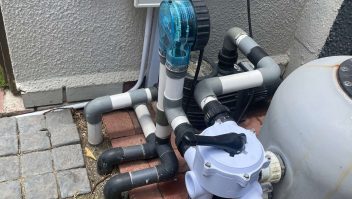
The right pool filter size depends on your pump as much as your pool. Most home pools in South Africa run a 3-bag sand filter with a 0.75kW pump, and that pairing exists for a reason: the filter is built to handle the water that pump pushes through it.
Get the match wrong and you’ll see it in the water and on the pressure gauge long before you see it on a bill. Here’s the pairing chart our team works from, then how to check it for your own pool.
| Pool volume | Pump | Sand filter | Sand it holds |
|---|---|---|---|
| Up to about 30,000 litres | 0.37kW to 0.45kW | 1-bag or 2-bag | 40kg to 80kg |
| About 30,000 to 50,000 litres | 0.45kW to 0.6kW | 2-bag | 80kg |
| About 50,000 to 80,000 litres | 0.75kW | 3-bag | 120kg |
| About 80,000 to 100,000 litres | 1.1kW | 4-bag | 160kg |
| Over 100,000 litres, or big water features | 1.5kW | 5-bag or larger | 200kg and up |
Why Pool Filter Size Is About the Pump, Not Just the Pool
A sand filter cleans water by letting it trickle down through a deep bed of sand. The sand only catches fine dirt if the water moves through it slowly enough. Every filter has a maximum flow rate, printed on the label in cubic metres an hour (m³/h).
Your pump sets the flow. A bigger pump pushes more water through the same tank, faster. Past the filter’s rating, the water starts forcing channels through the sand and dirt goes straight back into the pool.
So the question isn’t only “how big is my pool?” It’s “how much water does my pump actually move, and can this filter handle it?” If you’re still choosing the pump, start with our guide to pool pump sizes, then match the filter to it.

What Happens When the Pool Filter Size Is Wrong
Filter too small for the pump
- Pressure gauge climbs high straight after a backwash
- You need to backwash every few days
- Water stays dull or cloudy even with good chemistry
- Sand or fine dirt blows back into the pool
- Lids, O-rings and multiport valves start leaking under the strain
Filter too big for the pump
- Backwashing doesn’t lift and clean the whole sand bed
- Sand clumps into mudballs and channels over time
- You paid more for the filter and the sand than you needed to
- Usually less harmful than an undersized filter, but not ideal
Of the two, a filter that’s slightly too big is the safer mistake. A filter that’s too small is the one we replace most, usually after someone has fitted a bigger pump to run a cleaner or a water feature and kept the old filter.
How to Work Out the Right Pool Filter Size for Your Pool
- Work out your pool volume. Length x width x average depth in metres, x 1,000, gives litres. A 9m x 4m pool with an average depth of 1.4m holds about 50,000 litres.
- Decide on a turnover time. Most home pools should pass all their water through the filter in about 6 to 8 hours.
- Work out the flow you need. Divide the volume by the hours. 50,000 litres over 8 hours is about 6.3 m³/h.
- Check what your pump really delivers. Long pipe runs, a pool cleaner and water features all cut a pump’s real flow below the figure on the box.
- Pick a filter rated above that flow. The filter’s maximum flow rating must sit above what your pump delivers, with some room to spare.
Worked example
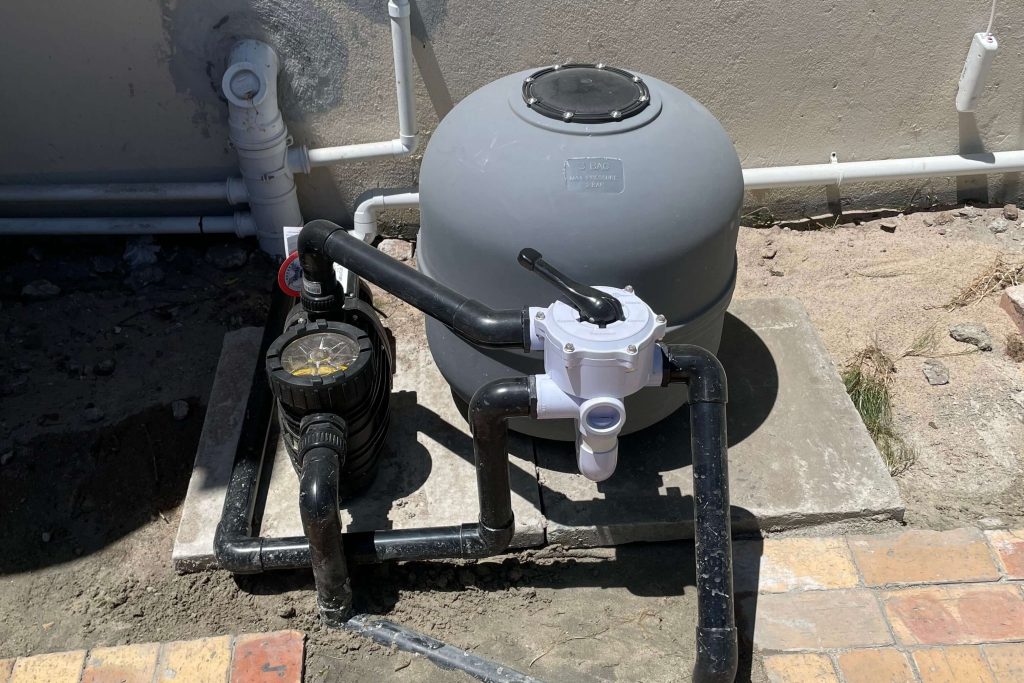
A 50,000 litre family pool needs roughly 6 to 8 m³/h. A 0.75kW pump comfortably delivers that, and a 3-bag sand filter is rated to handle it. That’s why the 0.75kW and 3-bag pairing is the standard set-up on so many Cape pools. Put a 1.1kW pump on that same filter and you’re asking it to handle far more water than it was built for.
To find out exactly how much swimming pool filter sand a particular tank takes, use our sand filter calculator.
Does the Filter Type Change the Size You Need?
A little. Glass media goes into the same tank as sand, but you need less of it by weight, and many people find it catches finer dirt. Cartridge and DE filters are sized differently, by the filter area in square metres rather than by bags. If you’re weighing up a pool cartridge filter or DE instead of sand, our comparison guide covers the pros and cons of each.
Upgrading a Pump? Check the Pool Filter Size Too
This is where most mismatches start. A homeowner upgrades the pump, or adds a water feature, a pressure cleaner or a booster, and nobody looks at the filter. A few months later the gauge is high, the multiport is weeping and the water won’t polish.
- Going up a pump size? Plan on going up a filter size as well.
- Going to a variable-speed pump? Your existing filter is usually fine, because these pumps run at lower flow most of the day.
- Going solar? A solar pool pump still has to push water through the same filter, so check the pairing before you buy.
- Old filter, new pump? If the filter is more than ten years old, replacing both at once usually works out cheaper than two separate call-outs.
If you’re pricing a new pump at the same time, our pool pump prices guide sets out current costs and when a repair is the better buy.
Signs Your Filter and Pump Are Badly Matched
- The gauge reads well above its normal clean level within a day or two of backwashing. Our guide to the pool filter pressure gauge explains what normal looks like.
- You need a pool backwash far more often than once a week in summer.
- Fine sand collects on the pool floor near the return jets.
- The pump sounds strained, or the flow from the return jets is weak even with clean baskets.
Pool Filter Prices by Size
These are shelf prices for the filter tank and multiport valve at South African pool suppliers in October 2026. Sand is extra, at roughly R140 to R270 per 40kg bag.
| Filter size | Usual pump | Price range (incl. VAT) |
|---|---|---|
| 2-bag sand filter | 0.45kW to 0.6kW | From around R2,400 to R4,000 |
| 3-bag sand filter | 0.75kW | From around R2,500 to R4,800 |
| 4-bag sand filter | 1.1kW | From around R3,000 to R5,500 |
| 5-bag sand filter | 1.1kW to 1.5kW | From around R3,200 to R7,500 |
Fitting adds to that, especially if the plumbing has to be reworked to suit a bigger tank or a different valve. If your old filter is cracked, leaking or past its best, see our guide to swimming pool sand filter replacement for the warning signs.
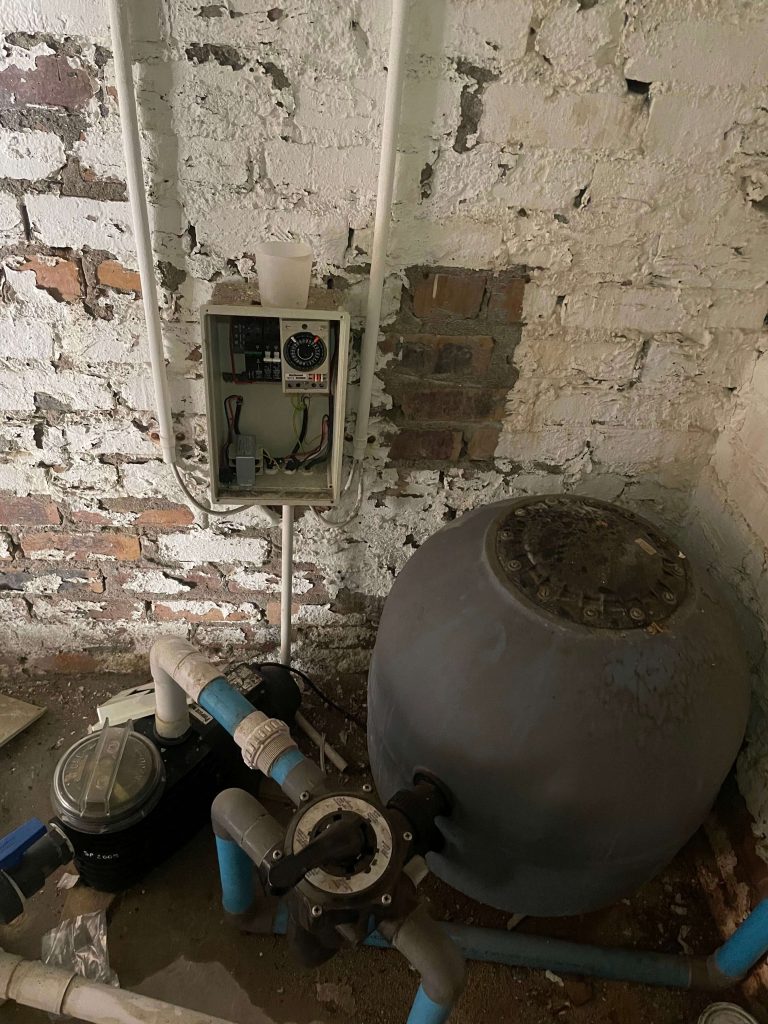
Safety first
Always switch the pump off at the board before you check a filter, open a lid or turn the multiport handle. Never open a filter that’s still under pressure. If the gauge stays high after a backwash or the filter is leaking, call our team rather than forcing anything.
Not sure your filter and pump are a good match?
Send us a photo of your pump, filter and the labels on both. We’ll tell you whether they’re matched, and quote for a properly sized filter or a pump and filter pair if they aren’t.
Call 074 378 6623, WhatsApp us, or email info@poolsreno.co.za. If the pump itself is giving trouble, we also do pool pump repair.
Pool Filter Size: Frequently Asked Questions
Most 50,000 litre pools run well on a 3-bag sand filter paired with a 0.75kW pump. A 2-bag filter can work on the smaller end with a 0.6kW pump, but a 3-bag gives you more margin and longer runs between backwashes.
Yes, but it’s the lesser problem. A very large filter on a small pump may not backwash properly, so the sand clumps over time. A filter that’s too small for the pump causes far more trouble.
It means the tank holds three 40kg bags of filter sand, so 120kg in total. Filters in South Africa are sized this way, from 1-bag units for small pools up to 5-bag and larger for big pools and water features.
Usually yes. A bigger pump pushes more water through the filter, and if that goes past the filter’s rated flow, dirt is forced back into the pool. Check the flow rating on the filter label before upgrading the pump.
Look for a label on the tank showing the model, the sand capacity and the maximum flow rate. If the label has faded, measure the tank’s diameter and send us a photo, and we can usually tell you from that.