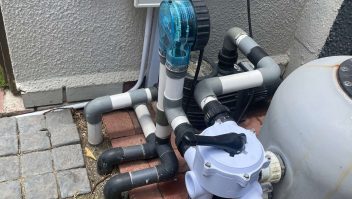
A variable speed pool pump can cut the electricity your pool uses for filtering by half or more. On a typical Cape Town pool that works out to a few hundred rand a month, which is why our team gets asked about them every summer. The catch is that the saving only shows up if the pump is set to run slowly for longer. Fit one and leave it on full speed, and you’ve paid extra for a pump that costs about the same to run as the old one.
Below we show the sums, using real tariffs and honest assumptions, so you can see what a variable speed pool pump would save on your pool.
The short version
- Run a pump at half speed and it moves about half the water but uses roughly an eighth of the power, in theory.
- You run it for longer to move the same water, so the real saving is usually 50% to 75% of what the old pump used.
- In our worked example below, that’s roughly R5,300 a year on a Cape Town tariff.
- The saving shrinks on small pools with short run times, and on pools that need high speed for a cleaner or water feature.
Why a Variable Speed Pool Pump Uses So Much Less Power
A normal pool pump has one speed: flat out. A variable speed pool pump, also sold as an inverter pool pump, has a motor and drive that let you choose how fast it spins. That matters because of a basic rule of pumps. Flow drops in step with speed, but the power the motor needs drops much faster, roughly with the cube of the speed.
| Pump speed | Water moved | Power used (theory) |
|---|---|---|
| 100% | 100% | 100% |
| 75% | About 75% | About 42% |
| 50% | About 50% | About 13% |
| 33% | About 33% | About 4% |
So if you halve the speed and double the hours, the pool still gets the same amount of water through the filter, but the pump uses around a quarter of the energy. Slower water also filters better, because the sand has more time to catch fine dirt, and the pump is far quieter.
How Much a Variable Speed Pool Pump Saves: The Sums
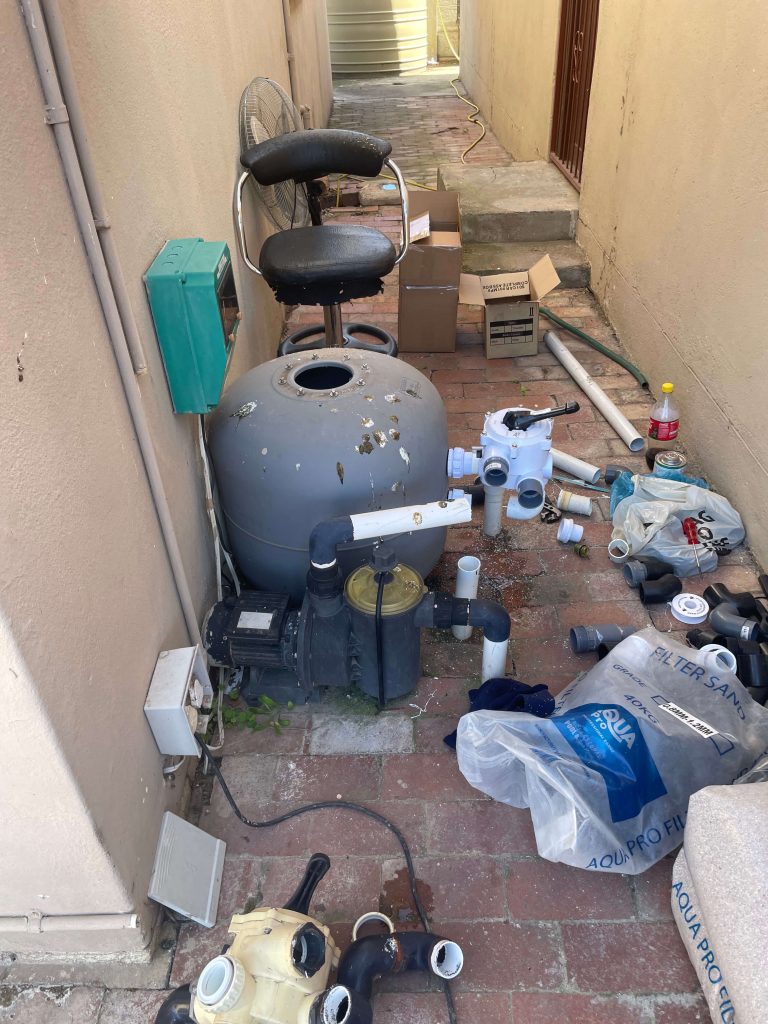
Here’s a worked example for a typical home pool of around 50,000 litres. We’ve kept the assumptions simple so you can swap in your own.
- Tariff: R4.69 a unit (kWh). That’s the City of Cape Town’s 2026/27 Home User rate above 600 units a month, including VAT. Pool pump units usually land in that top block because they sit on top of the rest of the house. Prepaid Domestic customers pay up to R4.94.
- Old pump: a 0.75kW single-speed pump drawing about 1kW at the wall.
- New pump: a variable speed pump of the same size, set to about 0.2kW on low and about 0.9kW on high.
- Run times: 8 hours a day in summer and 5 in winter for the old pump, in line with what we recommend for Cape Town pools.
| Single-speed pump | Variable speed pump | |
|---|---|---|
| Summer daily run | 8 hours at 1kW = 8 units | 12 hours on low (2.4 units) + 2 hours on high (1.8 units) = 4.2 units |
| Summer month (30 days) | 240 units = about R1,130 | 126 units = about R590 |
| Winter daily run | 5 hours at 1kW = 5 units | 8 hours on low (1.6 units) + 1 hour on high (0.9 units) = 2.5 units |
| Winter month (30 days) | 150 units = about R700 | 75 units = about R350 |
| Rough year (6 summer, 6 winter months) | About R10,980 | About R5,660 |
In this example the variable speed pump saves about R535 a month in summer, around R350 a month in winter, and roughly R5,300 over a year. Notice that it runs for more hours, not fewer. That’s the whole trick.
How Long Before It Pays for Itself?
A variable speed pump costs a good deal more to buy than a single-speed one. Our guide to pool pump prices sets out current prices, and at the time of writing the gap for a typical 0.75kW pump was roughly R5,000 to R7,000. Set against a saving of about R5,300 a year, that’s a payback of somewhere around one to one and a half years in our example. Electricity tariffs in Cape Town have gone up every July for years, so the saving tends to grow over the life of the pump.
Work out your own saving
Find the power rating on your pump’s label and your rate per unit on your municipal or Eskom bill. Then:
- Old pump: kW x hours a day x 30 x your rate = cost a month
- Variable speed pump: (low-speed kW x low hours) + (high-speed kW x high hours), x 30 x your rate
- The difference is your monthly saving. Divide the extra cost of the pump by it to get the payback in months.
When a Variable Speed Pool Pump Saves Less
We’d rather you hear this from us before you buy. These are the cases where the saving gets smaller:
Big saving likely
- Pools that run 6 hours a day or more
- Medium to large pools, roughly 40,000 litres and up
- An old pump that’s oversized for the pool and filter
- Pools where the pump runs right through summer
- Homes where the pool units fall in the top tariff block
Smaller saving
- Small pools and splash pools that only need a few hours a day
- Suction cleaners that need high speed for most of the run
- Water features that only look right at full flow
- A pump left on high because nobody set the program
- Pools that sit idle for months in winter
A suction pool cleaner is the big one. Many cleaners won’t move properly on a very low speed, so the pump has to run faster while the cleaner is in. The answer is to give the cleaner its own two or three hours on a higher setting and run the rest of the day on low, rather than running everything on high.
Setting Up a Variable Speed Pool Pump So It Actually Saves
Most variable speed pumps have a built-in timer with several speed steps. This is the kind of program our team sets on a typical Western Cape pool in summer:
- Early morning, 2 hours on high. Clears overnight leaves into the skimmer and runs the cleaner.
- Through the day, 8 to 10 hours on low. Quiet, cheap filtering while the sun burns off chlorine and the pool is in use.
- Late afternoon, 1 hour on medium. Skims off the day’s dust and the leaves the south-easter dropped.
- Backwash on high, whenever the filter pressure says it’s time. A low speed won’t lift the dirt out of the sand properly.
In winter, cut the low-speed hours back and keep a short high-speed run for the skimmer. If your pump doesn’t have its own clock, a separate pool pump timer can handle on and off times, but the speed steps are set on the pump itself. Our guide on how to backwash a pool explains the steps. Always backwash on high speed.
Salt Chlorinators Need Enough Flow
If your pool runs on a salt chlorinator, the cell only makes chlorine while water flows through it, and most cells have a flow switch that shuts them off below a certain flow. Set the low speed too low and the chlorinator quietly stops working. We set the lowest speed that still keeps the cell running, and we usually add a few extra low-speed hours to make up the chlorine.
Choosing the Right Size of Variable Speed Pool Pump
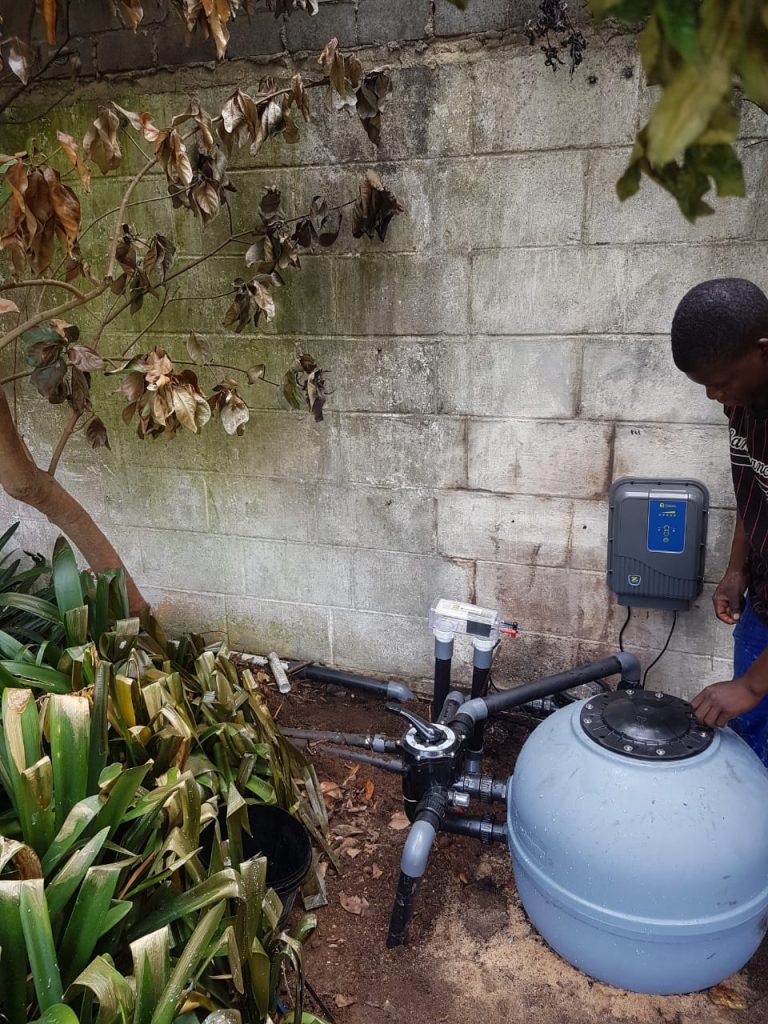
With a single-speed pump, oversizing wastes power every hour it runs. With a variable speed pool pump, a slightly bigger model costs very little extra to run because it spends most of its life on low. What matters more is the plumbing. Long pipe runs, narrow pipes and lots of bends make any pump work harder, so the low speed has to be set higher to get the same flow.
Our calculator for pool pump sizes is a good starting point. The pump also has to match your pool filter, especially on high speed.
Variable Speed Pumps in Western Cape Conditions
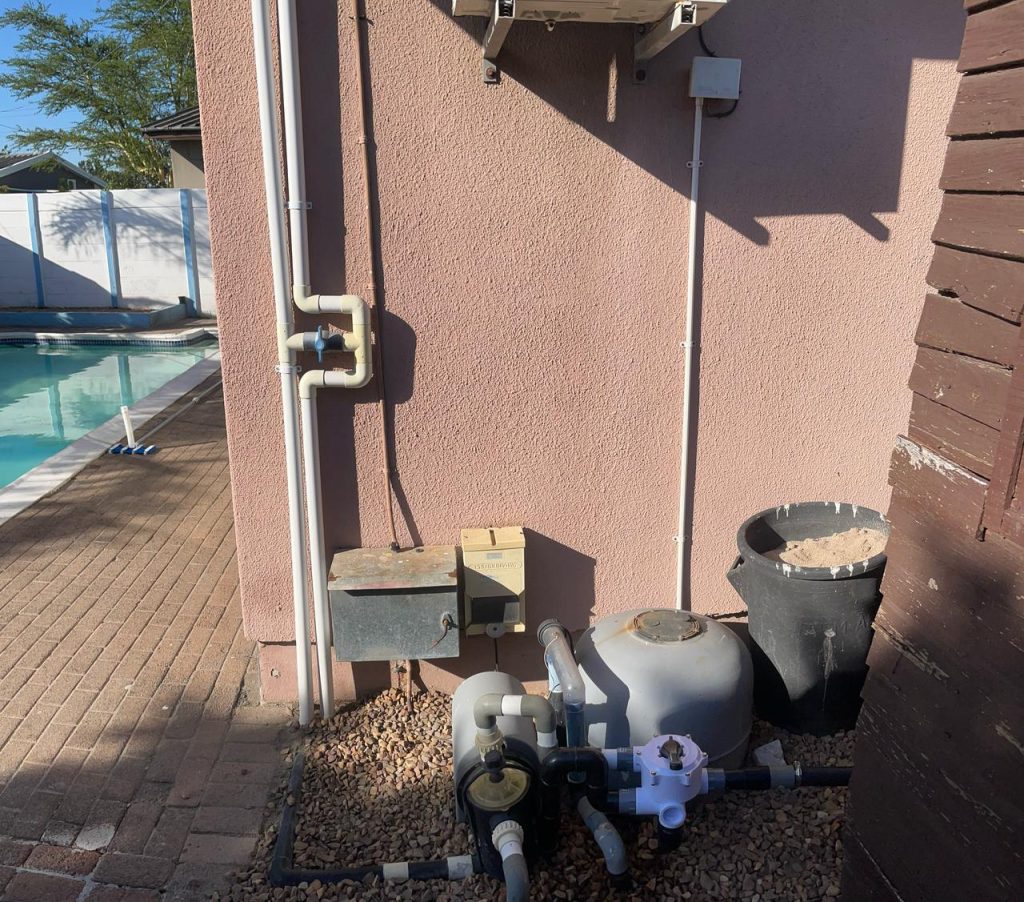
- Power cuts and backup power. A variable speed pump starts gently and draws far less current on low, which makes it much easier to run off a home inverter and battery than an old single-speed motor that kicks hard on start-up.
- Autumn leaves. Low speed means weaker skimming, so give the pool a high-speed run after windy days and keep baskets clear.
- Coastal salt air. The drive electronics sit in the motor housing. A ventilated cover that keeps off rain and sea spray, without trapping heat, helps them last.
- Flooding pump pits. Electronics and standing water don’t mix. The pump should sit above the floor of the pit with a way for winter rain to drain.
Wiring is electrician work
A variable speed pump is wired to the mains next to water. The electrical connection, isolator and earth must be done by a qualified electrician or a pool company that works with one, with the power off at the board. Setting the speeds and timer is fine to do yourself once it’s installed.
Is a Variable Speed Pool Pump Worth It for Your Pool?
If your pump runs most of the day in summer, your pool is a normal family size and you’re paying Cape Town tariffs, a variable speed pool pump usually pays for itself within a year or two and keeps saving after that. If you’ve got a small pool that only needs a few hours of filtering, a correctly sized single-speed pump on a good timer may be the better buy.
If your current pump is failing anyway, it’s the cheapest time to switch, because you’re paying for fitting regardless. If it’s running fine, compare the saving with the cost and decide on the numbers. And if the old pump is just noisy or leaking, a pool pump repair may buy you a few more years first. Our page on pool pump installation explains what a proper swap involves.
Want the sums done for your pool?
Send us your pump’s label, your pool size and your rate per unit, and our team will tell you honestly what a variable speed pump would save and what it would cost fitted.
Call 074 378 6623, WhatsApp us, or email info@poolsreno.co.za.
Variable Speed Pool Pump Questions
Yes, when they’re set to run slowly for longer. Because power drops much faster than flow, a pump on low uses a fraction of the electricity. Left on high all day, it saves very little.
On low, many home variable speed pumps draw only a couple of hundred watts, against about 1kW for a typical 0.75kW single-speed pump. On high they use about the same as a normal pump of the same size.
Run it on the lowest speed that still turns the water over, keeps the skimmer working and keeps any salt chlorinator switched on. Add a short high-speed run each day for skimming or a cleaner, and always backwash on high.
Usually longer than your old pump, often 10 to 14 hours on low in summer and less in winter. The extra hours are cheap because the pump is using so little power.
In practice, yes. The inverter is the electronic drive that lets the motor run at different speeds. Some brands call them inverter pumps, others call them variable speed pumps.
Usually more easily than a single-speed pump, because it starts gently and draws much less on low. Check the pump’s power rating against your inverter and battery, and have an electrician confirm the connection.