A pool pump should make a steady, even hum. When your pool pump starts making noise it didn’t make before, the sound itself is the best clue you’ll get. Grinding usually means bearings. A rattle like gravel means the pump is starved of water. Humming without spinning points to the capacitor or a jammed motor.
Some of these you can sort out yourself in ten minutes. Others mean switch the pump off now, before a small repair becomes a new motor. Here’s how to tell which is which.
| What you hear | Most likely cause | What to do |
|---|---|---|
| Gravel or marbles rattling inside | Pump starved of water (cavitation) | Clear baskets, check water level and valves |
| Gurgling, air in the pump lid | Air getting in on the suction side | Check water level, lid and O-ring |
| Grinding, screeching or squealing | Worn motor bearings | Switch off and call our team |
| Loud hum, motor won’t turn | Capacitor or seized motor | Switch off at once and call us |
| Rattling or vibrating | Loose mounting, uneven base, pipes touching a wall | Check the base and pipework |
| Clicking or scraping | Debris in the impeller or a rubbing fan cover | Switch off and call our team |
Switch off at the board first
Before you touch anything, switch the pump off at the board, not only at the timer. Never open the motor, poke inside the pump or touch wiring. A noisy pool pump that’s grinding, humming without turning or smelling hot should stay off until it has been checked.
What Each Noisy Pool Pump Sound Means
Gravel in a Tin: the Pump Is Starved of Water
A rattling, crackling sound, like stones going round inside the pump, is usually cavitation. The pump can’t get enough water, so bubbles form and collapse around the impeller. It’s loud, and over time it chews up the impeller and the seal.
- A packed skimmer or pump basket, very common in autumn
- Water level too low, so the skimmer gulps air
- A suction valve half closed after backwashing
- Leaves or a stone jammed in the pool pump impeller
- A pump that’s too big for the pipework, so it pulls harder than the pipes can feed it
Gurgling and Bubbles: Air Getting In
If you can see bubbles in the pump lid or hear gurgling, air is getting into the suction side. Low water is the first thing to check, then the pump lid and its O-ring. A pump that keeps losing water from the lid is closely related, and our guide to a pool pump not sucking water covers it step by step.
Grinding or Screeching: Pool Pump Loud From Worn Bearings
A grinding, howling or high-pitched screech that gets worse over days or weeks is almost always the motor bearings. Very often it follows a leak: water drips past a worn shaft seal and gets into the bearings. If your pump has been dripping between the pump body and the motor, fix the pool pump seal before it takes the bearings with it.
Bearings sit inside the motor, so this is a workshop job for our team, not a home fix. A pump that’s left to scream will usually end with a burnt-out motor.
Pool Pump Humming but Not Turning
A loud hum with no water moving means the motor is getting power but can’t start. On most single-speed pumps the culprit is the start capacitor, especially after a power cut or surge. A seized motor or a jammed impeller does the same thing.
Switch it off straight away. A motor left humming against a jam overheats in minutes. Our guide to the swimming pool pump capacitor explains the fault, but testing and replacing it is electrical work, so leave that part to our team.
Rattling, Vibration and Clicking
Rattles often aren’t the pump at all. A pump standing on a cracked or uneven base, loose mounting bolts, or pipes knocking against a wall can make a lot of noise. A ticking or scraping sound is different: it can be debris caught in the impeller or the motor’s fan cover rubbing on the fan. Both need the pump switched off and checked.
Safe Checks for a Pool Pump Making Noise
Do these in order, with the pump switched off at the board. Most cavitation and air problems are solved somewhere in this list.
- Empty the skimmer basket and the pump basket. Check the baskets aren’t cracked.
- Check the water level. It should sit around halfway up the skimmer opening.
- Make sure every valve on the suction side is fully open.
- Check the pump lid is seated and hand-tight, and the O-ring isn’t flattened, cracked or dry.
- Look at the filter gauge. If the pressure is well above normal, backwash. Our guide to the pool filter pressure gauge shows what normal looks like.
- Check the pump sits level and firm, and no pipe is touching a wall or another pipe.
- Switch back on at the board and listen. If the noise is gone, keep an eye on it for a few days.
If the pump won’t hold water after you’ve cleaned the lid area, follow our steps on how to prime a pool pump before you run it again.
Switch off and call us if you notice
- Grinding, screeching or a noise that gets worse each day
- Humming without the motor turning
- A burning smell, or a motor too hot to rest your hand near
- The pump tripping the power or the earth leakage
- Water dripping from between the pump body and the motor
Western Cape Causes of a Noisy Pool Pump
A few local conditions turn up again and again when our team tracks down a noisy pool pump:
- Autumn leaves. Packed baskets starve the pump and cavitation starts within days.
- Winter rain. Pumps in sunken pits can stand in water, which wrecks bearings and is dangerous around electrics.
- Coastal salt air. Bolts, brackets and motor fan covers corrode and loosen, and loose parts rattle.
- Load shedding and surges. Capacitors take the hit, so a pump that hums after the power comes back is common.
- Hard water. In parts of the Boland, scale on the impeller cuts flow and adds to the strain.
When a Noisy Pool Pump Needs a Repair
Bearings, capacitors, seals and impellers are all repairable, and often well worth fixing. If the motor has burnt out on an old pump, replacing it can make more sense. Our guide to pool pump prices sets out what a new pump costs and how we decide between repair and replacement.
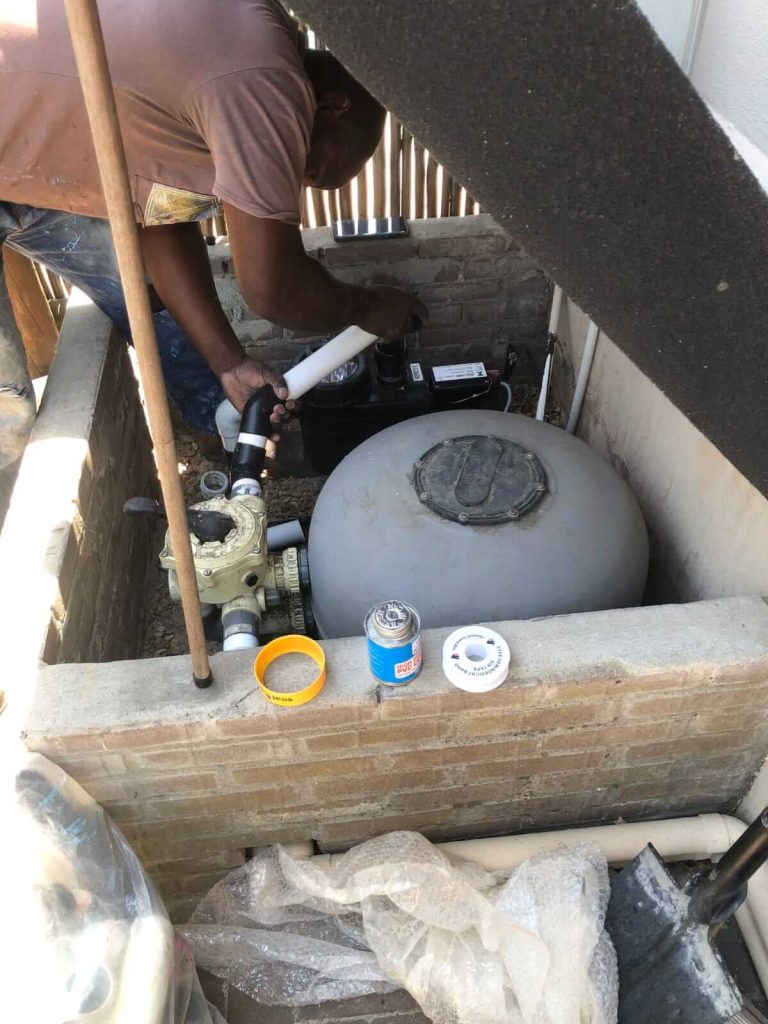
One more thing worth checking: an oversized pump is a noisy pump. If yours roars and the filter pressure sits high, it may simply be too big for the pool. Our calculator for pool pump sizes gives you a starting point. For other faults, see our swimming pool pump troubleshooting guide.
Pump still making noise?
If these checks don’t fix it, call our team. Record a short video of the sound on your phone and send it to us. It often tells us what’s wrong before we arrive, and we’ll quote before any work starts.
Call 074 378 6623, WhatsApp us, or email info@poolsreno.co.za. We handle pool pump repair and general swimming pool repair services.
Noisy Pool Pump: Frequently Asked Questions
The most common causes are a pump starved of water, air getting into the suction side, or worn motor bearings. A gravel-like rattle points to blocked baskets or low water. Grinding or screeching points to the bearings.
Usually the start capacitor has failed, or the motor or impeller is jammed. Switch it off straight away, because a motor left humming can burn out. Capacitor testing and replacement is electrical work for our team or an electrician.
Not if it’s grinding, screeching, humming without turning or smelling hot. Running it can turn a bearing or capacitor repair into a new motor. A rattle that stops once the baskets are cleared is fine to keep running.
Keep the baskets clear, the water level right and the valves open, and make sure the pump sits on a solid, level base with no pipes touching walls. A pump that’s oversized for the pool will always be louder, so check the size too.
Often, yes, if the motor is otherwise sound and the shaft seal is replaced at the same time. On an old pump with other problems, a new pump may make more sense. Our team will tell you which before any work starts.